 Nine a. m., as promised, I showed up at the police station on Greyfield Square. A young lady, looking most enticing in her green ribbed sweater and beige patterned skirt said, ‘Morning, Mr Corsair. I'm Jane. Come with me and meet Mr Thomson.’
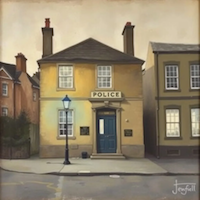 She led me from the front desk into Ellis Thomson’s office. The man himself was sitting behind the desk.
‘This is Sam Corsair, sir,’ she told him, ‘the consulting detective.’
‘Sam Corsair P. I.,’
I said to them both. ‘Pleased to meet you at last.’
‘I’m very glad you’re here,’ came the reply. ‘I hope you’ve had a good trip.’
‘I did. Comfortable flight, great hotel. Thanks for fixing it all up for me.’
‘Don’t thank me. Jane fixed it all up.’
‘That’s me,’ said the lady. She gave me a smile like the sun coming out from the clouds.
‘Jane here’s my secretary. Whatever you need, ask Jane. She can fix anything.’
‘Anything?’ I asked her.
‘Anything,’ she breathed, ‘For instance, I booked the Sandringham Hotel for you. You’ll have no complaints. Ellis is right, though. I can arrange absolutely anything.’ She put the emphasis on that word anything.
‘Taxi driver said the same thing as I left the Union Station. Marvellous.’
‘Union Station?’ Jane sounded as though she had never heard of the place. ‘Where’s that?’
‘Halfway along Main Street,’ I told her. ‘Railroad station — you must have noticed it.’
‘I think he means Waverley,’ said Ellis.
Come to think of it, that was the name, more or less.
‘And in this envelope,’ she picked up a manila envelope from Ellis’s desk and held it out to me, ‘here’s your warrant card and the keys to your car.’
‘My car?’ I thought I'd left it up an alley off Carlsberg Avenue, New York.
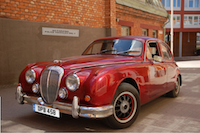 ‘The bright red Jaguar Mark One in the staff car park.’
‘I suppose it says, “Here come the cops, hide on the double!” in big letters on both sides.’
‘It’s unmarked, sir,’ Jane flashed another smile. ‘But it won’t go un-noticed.’
‘Jaguar Mark 1, best car that’s ever been made. That should leave an impression behind,’ I said.
I took the envelope. Jane turned on one shiny, black four-inch heel and clicked out of the office, with a look over her shoulder that said, ‘See you later.’ I watched after her. If her skirt had been any tighter, she would’ve fallen over.
I needed a few seconds to get my mind back onto the investigation.
‘Any progress with the case?’ I asked Ellis.
‘Things are not improving. There was another incident over the week-end.’
‘What happened? Was anyone hurt? Anyone been caught?’
‘No, nobody hurt, just a bit shaken. An attempted break-in that looks similar to the other break-ins.’
‘So it could be the guy we’re looking for.’
‘My own thoughts exactly. Corsair, I think the best thing would be for you to go and talk to the woman who appears to have been the intended victim. I don’t want to influence your findings and besides, it’d be best if you spoke to her before she forgets all about it. I’ll brief you when we have a bit of time on our hands.’
‘Sure, boss. Who and where?’
‘Her name’s Catríona Murray. She’s in the Grand Azure Hotel. Remember to drive on the left.’
The car was beautiful, but I got in, and at first I couldn’t find the steering wheel. Then I realised, of course, that I had to get into the car on the driver’s side. The right hand side. Even after that, I found it awkward to drive off, because the gear-change was on the wrong side. Who would want a left handed gear-change? Was every driver in Scotland left handed? But I did remember to drive on the left. I got honked at a few times, ’cause a car like that makes you enemies.
Ms Murray was an actress currently making a movie. When not actually performing, she hung out in the Grand Azure Hotel, which rambled impressively across large, afforested grounds in the west of the city. The Jaguar covered the ground easily and got me hard stares from the sidewalks. I showed the receptionist my warrant card and said the magic word. ‘Police. I’m looking for Catríona Murray.’
‘Is she in trouble?’ the receptionist asked.
‘No, just routine stuff,’ I said. ‘Which room’s she in?’
The receptionist told me that Ms Murray was on the VIP floor, Suite 516.
Every P. I. knows that a door is a dangerous thing. You never know who, or what, is on the other side of it.
I couldn’t draw my gun before banging on the door, because I didn’t have one. British police notoriously don’t carry guns. I couldn’t hammer on the door with my baton either, because I didn’t have a baton. Jeez, with no gun and no baton, how do these guys ever arrest anybody? In desperation, I took one shoe off, hammered on the door with the heel and bellowed, ‘L. B. P. D.!
Police! — Open up!’
 The door opened. The charming face and blonde hair that I recognised from a thousand margarine commercials looked straight at me and spoke pure California. Her hair was a bird’s nest, her dress was crumpled, her eye make-up was running down her cheeks and the mingled aromas of costly perfume and superior cognac flooded over me. ‘You’re new to Scotland, aren’t you, Officer?’
‘It’s my first day on the job,’ I said.
‘You’ll go far. Come in.’
‘I will,’ I said, ‘once I’ve put this shoe back on.’
Miss Murray was wearing a bright red dress that flashed and sparkled in the light.
‘You must excuse me,’ she said, ‘but I was at a party late last night and I was so tired afterwards that I slept in my clothes.’
‘You look fine to me.’
‘Are you here about the intruder?’
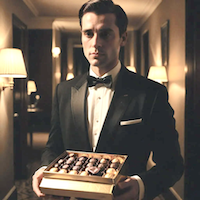
‘Yeah, I sure am. Do you want to tell me about him?’
‘Well, this morning when she came to tidy my room, the cleaner told me that yesterday morning, while she was cleaning in here, a man, handsome and very well dressed, walked into the room. ’Course she yelled at him to get out, and he did. But he didn’t look like a burglar. He fitted in with these plush surroundings.’
‘What did he look like? Tall, short, young, old, beard, glasses?’
‘I don’t know, Officer. The cleaner saw him. I didn’t.’
‘Is that all you know?’
‘Yes. Except for one strange thing.’
‘Which was?’
‘He was carrying a box of chocolates.’ Ms Murray’s expression was of pure incomprehension.
‘You’re kidding me.’
‘No. Straight up. The cleaner said he had a big, purple box of Chertsey chocolates.’
‘An American brand. Maybe he thinks you’re malnourished.’
‘Or homesick, maybe.’
‘I’ll need to speak to the cleaner, if I can find her. Did you get her name, by any chance?’
‘Uh-uh,’ meaning, ‘no.’
‘Can you describe her, then?’
‘Fifty years old, overweight, lots of rings—’
There was a gentle tap at the door.
‘Duty manager,’ said a man’s voice from the corridor. ‘Are you all right, Ms Murray?’
‘Perfectly,’ she said, loudly, without opening the door. ‘Nothing to worry about.’
‘I understand there was a bit of a kerfuffle here.’
‘Someone needed to talk with me.’
‘Tell him to stick to “ ’Ello, ’ello” in future.’
I thanked Ms Murray, I said goodbye to her and I hurried into the corridor, where the Duty Manager stopped me. Brylcreemed hair, charcoal suit, club tie, starched white shirt: could’ve been a tailor’s dummy.
‘Where are you going?’ he demanded.
‘Sam Corsair,’ I introduced myself, ‘L. B. P. D. Can you tell me who cleaned this room yesterday? I need to talk to her.’
‘I don’t know her name. An agency sends the cleaners.’
‘Great! Can you tell me which agency it is? I’ll need to rattle their cage.’
‘Spring Cleaning. I have their phone number somewhere.’ He fumbled for his wallet and gave me their business card.
‘Who’s your contact there?’
‘The owner. Joshua Spring,’ said the duty manager.
Things were looking up — I had my first eye-witness.

 I woke up in the Sandringham at about seven in the morning. I’d slept well without the street-cars of Carlsberg Avenue rattling me awake every thirty minutes.
The restaurant served Scottish breakfast. I could see what that involved because, all around me, other customers were eating from the same menu. How did people eat all that? I never saw so much food on the same plate. I was surprised that it all fitted. Eating all that — if I could eat all that — was going to take a while, so I took the pencil out of my shirt pocket, picked up the paper napkin off the table, and told my pencil that I was fresh out of Basildon Bond but the napkin was perfectly good stationery. Then the waitress, early twenties, false eyelashes, cute face, said ‘Good morning, Mr Corsair,’ and brought me an orange juice, a dish of oatmeal, a jar of honey and a teaspoon. I spooned honey into the oatmeal and I tried to get my thoughts into order.
One, I wrote, and underlined it.
Someone had gone into Catríona Murray’s room at the Grand Azure hotel.
I took a spoonful of oatmeal. Two.
The cleaner was working in Ms Murray’s room at the time. She (or was it he? Probably not) had asked the intruder to leave. He left. He didn’t argue or make any trouble.
Three.
The intruder was well dressed and he was carrying a box of chocolates.
Four.
The cleaner had been sent by an agency called Spring Cleaning.
I had finished the oatmeal and drunk the orange juice. The waitress brought me bacon, eggs, a sausage and a whole fry-up. Did they have maple syrup that I could pour over it, I asked. No, she said, they were clean out of it, but they’d get some for me by tomorrow. Did they have some coffee? Yes. Viennese, with cream and two sugars? She fetched it. It tasted every bit as good as the coffee from Fat Bruno’s shack in Statue Park, who could brew coffee for the Olympics.
I stabbed a round grey thing with my fork, cut it in two and ate half of it. Not bad, even though I had no idea what it was.
I carried on writing my list.
Five.
Spring Cleaning have an office at 60 Moray Circus. The boss of Spring Cleaning was called Joshua Spring. I had his business card in my wallet.
A thought struck me. I went back to point three and I added, ‘Not just any chocolates. Chertsey chocolates.’ Not a brand you’d buy to impress a lady, but an ordinary, work-a-day brand. The sort you buy to keep the kids quiet while you call your mistress. You never know, it might turn out to be important.
I sat still for a couple of minutes but I didn’t think of anything else. So far, so good. Touch wood, I had an eye-witness.
The waitress took my empty coffee cup, replaced it with a fresh, full one, and asked, ‘What do you think of haggis?’
‘Was that the round, grey slice of stuff?’
‘Yes, sir.’
Truth to tell, I couldn’t remember what it tasted like, so I said, ‘Absolutely delicious. Worth coming all the way from New York just to try it. Can you ask the Chef to wrap one up for me? Small enough to fit in the glove compartment. I can eat it for lunch.’
‘I’ll see what I can do,’ she said.
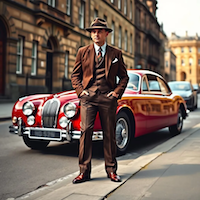 With the slice in the dash, I started the car and headed to Moray Circus a couple of miles away. It was a short, curved street, specially designed so that there was nowhere you could park by the kerb and not be run into by a speeding fire engine, or a ten ton truck being driven like one. Number 60 was a dusty wooden door with a fan-light and a brass handle that worked the doorbell. I’d found the right place. There was a very respectable black metal plate on the door with gold coloured writing etched on it. Spring Cleaning. First floor. Ring bell and wait, so I rang, I heard a bell ring somewhere on a floor above me, and I waited.
I heard distant footsteps, and with much creaking, the door opened. Behind it was a windowless box of a room maybe ten feet square, painted blue below the waist and cream above, and lit by one bare electric light bulb and what sunshine made it through the fanlight. It smelled of damp and dust. The man who opened the door was Mid East in appearance, bald, in a maroon cardigan, open neck shirt and grey pants. ‘This way,’ he said. There was only one way, a flight of stone steps going up. There was a letter-box on the back of the door. The man took a couple of letters out of the box and carried them with him. They were brown ones with windows. It seemed he had the same business problems that I did.
At the top of the stairs there were a couple of unmarked doors, and we went through the one on the left. It led into an office with enough room for a desk and a filing cabinet. On the desk, there were a phone and a tray for letters.
‘Good morning. Are you Joshua Spring?’ I asked.
‘Yes, sir. Trading as Spring Cleaning, employment agency.’
‘Sam Corsair, P. I., Lothian and Borders Police Department.’
‘I am most pleased to meet you,’ Mr Spring beamed. ‘In what may I assist you?’
‘Do you send a cleaner to the Grand Azure Hotel?’
‘Why, yes indeed.’
‘It’s very important I speak with her. I think she witnessed a crime being committed. Or maybe being attempted.’
‘Oh, dear. I hope she is not in trouble.’
‘Not at all. She ain’t got nothing to worry about. I just need to talk to her, that’s all.’
Mr Springer rifled through a box of index cards, found one and read it to me.
‘Her name is Soraya. Soraya Figueroa.’
‘How long’s she worked for you?’
‘Her first engagement was the tenth of August 1953. She has worked in the Grand Azure many weeks since then.’
‘You got her address?’
‘I have only her telephone number,’ he said.
‘Telephone number? How does a cleaner pay the bill for a telephone?’
‘That, I cannot say.’
Mr Spring wrote the number on a piece of scrap paper and gave it to me. I folded it and stored it in my wallet.
‘Thank you,’ I said, ‘Thanks for helping.’
‘Oh, it was nothing, I assure you.’
It was far from nothing. All I needed to do was talk to Soraya Figueroa, and I’d be away to a flying start.
Three p. m. I’d driven back to Greyfield Square. Just opposite the Police station, there was a terrace of half a dozen shops. Oak Terrace. I’d noticed a café shop that smelled okay.
They didn’t know what Viennese coffee was so I took a large paper cup of whatever was strongest, put a lid onto it and walked across. Jane said hi and told me that Ellis was in his office.
I knocked. Ellis was anxious to know what progress I’d made. I asked if there’d been any more break-ins. No, there were none. So I told him I had the phone number of an eye-witness.
‘Have you rung it yet?’
‘No, I haven’t. This is the first time I’ve been near a phone.’
‘Use mine,’ said Ellis, waving his arm towards the phone on the desk. ‘Go ahead, try it, don’t hang about,’ he told me.
I dialled the number. I didn’t hear it ring. I heard a strange noise, so I tried again. Again I heard the strange noise.
I held out the receiver to Ellis. ‘What’s this noise?’ I asked him.
Ellis took a listen and said, ‘That’s an unobtainable tone, Sam. It means there’s no such number.’
‘What do you mean, there ain’t no such number?’
‘It means the phone number doesn’t exist, or it doesn’t work, or the subscriber hasn’t paid the bill. Try talking to the operator.’
I called the operator.
‘She says the number doesn’t exist.’
‘Then you won’t be able to ring it,’ said Ellis. I’d worked that out for myself. ‘Not much you can do, unless whoever gave you the number wasn’t wearing glasses.’
‘Well, no, he wasn’t,’ I recalled.
‘Then he probably mis-read the number from his files. Go back and ask him to double check.’
That made sense. But we New Yorkers have a saying. Never do today what you can put off until tomorrow. I decided this could wait until tomorrow.
I went and sat in the office that Ellis had found for me. I drank the coffee and I ate the slice of haggis. Strange stuff, I thought. Then Jane came in without knocking and asked quietly, whether I had five minutes. I said sure, I had five minutes, but after six minutes I was going back to the Sandringham.
Jane said, ‘I don’t know much about men’s tastes, Mr Corsair. Could you advise me?’
‘Sure. What’s the problem?’
Leaning forward farther than necessary, Jane released an evocative cloud of perfume and showed me a lingerie catalogue. She turned to a page with three styles of nightwear on it, all of them seductive, and she asked me which one I liked best. Any of them would have attracted me, I thought, but I said, the red one.
‘This one here?’ she asked, pointing at the red one.
‘Yes, that’s definitely the one for me.’
‘Do you think I’d look good in that?’
‘Stunning,’ I said, ‘irresistible.’
‘Sam,’ she said, picking up the catalogue, ‘I have a favour to ask you.’
‘Ask away, lady.’
‘I have a hot date tonight at the Sandringham,’ she told me. ‘Could you give me a lift over there?’
‘He’s a lucky man,’ I said. ‘Who is he?’
‘Blind date,’ she said. ‘And, anyway, I always wanted to ride in a Jaguar.’
Jane went to fetch her bag, then I gave her a ride to the Sandringham and I left her to meet her new friend in the hotel bar.

I took to my bed around eleven. I’d just made myself comfortable when there was a quiet tap on the door.
A lady’s voice called, ‘Room service.’
‘I didn’t order room service.’
‘One Viennese coffee and someone to share it with.’
I was intrigued. ‘Who is it?’
‘Only me,’ said the voice.
I opened the door, and there was Jane, from the office, wearing a short red dress wrapped tightly around the curves of her body and carrying a china cup of coffee.
‘Sam!’ Jane put one arm around me and pulled me into a kiss. Somehow she managed it without spilling the coffee. ‘This is for you. Are you going to invite me in?’
I was transfixed. ‘Sure thing, doll. Come in.’ I took the coffee, put it on the table and shut the door behind her. ‘What happened to your hot date?’
‘He never showed up.’
‘You’ve been drinking alone?’
‘Two glasses of wine. Help me take the dress off.’
‘You sure about this?’
‘I never wanted anyone more. Don’t rush.’
We lay down together and twined our arms around each other. ‘See?’ she said, ‘I said I could fix anything.’
 After a wonderful night, we woke together.
I dropped Jane off at Greyfield Square.
She smiled and told me to have dinner at half past seven in the hotel.
Then I threaded through the architecture of the New Town back to 60 Moray Circus.
Where else is there a New Town that was built in the eighteenth century? They ought to call it something else, like the Old Town. Or the Extremely Old Town. That would do.
I walked up to the blue front door.
The sign on the door had changed.
It no longer said, ‘Spring Cleaning.’ Now it read, ‘Happy Land Tarot Readings and Palmistry. First Floor.’ Followed by the inevitable ‘Ring Bell and Wait.’
I banged my knuckles on the door. ‘L. B. P. D! Open up.’ I knocked so hard that the sign fell off the door onto the step, and it landed face down. On the back was the sign that I’d seen here yesterday: ‘Spring Cleaning.’ It looked as though somebody had left in a hurry and really didn’t want to see me again.
I picked the sign up, avoiding the glue that had been sticking it onto the door.
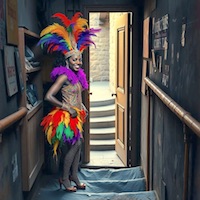 A slender Black woman in a flamboyant, brilliantly coloured Carnival outfit opened the door. If you’d caught sight of that outfit out of the corner of your eye, you’d have thought the room had caught fire.
‘Morning, Officer.’ Trinidad accent. I would have known it anywhere.
‘I’m Sam Corsair, P. I.,’ I said. ‘I’m looking for Joshua Spring. You ever heard of him? Do you know where he is?’
‘Chahrazad Sihème’ She introduced herself. ‘I never heard of him. Do you want to come up to my office?’
We climbed the stairs. Not only was the office in the same place as it was yesterday, but it was equipped with the same furniture as yesterday, apart from a crystal ball and two decks of cards on the coffee table.
‘He was here yesterday,’ I said, ‘sitting in that chair. A lot uglier than you but he knows something that I want to find out about.’
‘I was in this chair from nine to five yesterday with an hour for lunch and two fifteen-minute tea breaks, doing tarots and divining the future.’
‘Mind if I take a look around your office?’
‘If you think Joshua Spring might be hiding in the filing cabinet, sure, be my guest, but don’t upset the Spirit World,’ she told me. ‘They scare easily and they can be pretty vindictive.’
I thought, in that outfit, she would scare the entire spirit world to Kingdom Come, but I kept it to myself. ‘How do you spell that name?’ I asked instead.
She laughed.
‘How long have you worked in this office?’ I asked.
‘I moved in…’ She paused for thought. ‘July 1953.’
‘Almost two and a half years,’ I worked out. ‘Are you sure about that?’
‘Sure I’m sure. But if you want the exact date, you can ask
House to House Removals.
They moved me in here.’
‘I might just do that.’
‘Want me to ask the Spirit World where Joshua Spring got to?’ Chahrazad asked me.
‘Sure,’ I said. ‘They can’t know less than I do. How much is this celestial divination going to cost the Police Department?’
Chahrazad plucked a figure from the air. ‘How about five shillings?’
I paid the lady, who must have divined the exact amount of cash I had on me and then asked for it. Two heavy silver coins. British money weighs a ton. No wonder the British invented cheques. Where do the Brits get enough strength to carry enough money for a day's cups of tea, bus fares and tinned food? She gave the deck of cards to me and told me to shuffle it. I did. Then she took the cards back, flourished one hand over them and dealt herself four cards. She made a show of turning the cards face up.
‘Nothing to worry about,’ she said, ‘there’s the Justice card. You’re going to get your man.’
‘Anything else I need to know?’
‘The Tower card. You’ll be stronger afterwards.’
‘Any richer?’
‘Not that I can see here. Sorry!’
‘Do the Spirits say anything about boxes of chocolates?’
‘Not that I can see,’ said Chahrazad. ‘Should they?’
‘You never know,’ I said, ‘there could have been.’
Without a search warrant and a team of cops to do the hard graft and sort out the fights, I wasn’t going to find out any more. I thanked Miss Sihème and left. I was sure going to miss her coat of many colours.
On the way out I looked at the other doors on the same stair, and I even spoke to the occupants when there were any. Nobody had heard of Joshua Spring. Nobody had even heard anything go bump in the night.
I motored back to Greyfield Square and, suddenly remembering what the coffee was like in the Police canteen, I parked on Oak Terrace and went into the café there. The cutie behind the counter smiled at me.
‘What can I get you?’
‘Your strongest coffee, in a paper cup with a lid.’
‘Black or white?’
‘I’ll sit in whichever section has the most room.’
For a moment, the lady seemed nonplussed. ‘I mean, do you want milk in your coffee?’
‘Oh. Now I understand. Give me coffee with milk.’
‘Sure. Ninepence.’
I reached into my pocket and I found it empty. I realised that the few British coins I had were somewhere in my room in the Sandringham. No panic. I still had a couple of dollar bills in my wallet. I held a dollar bill out to her.
‘Keep the change,’ I said.
‘I’m sorry,’ said the lady, who looked as though she had asked for bread and been offered a stone. ‘That’s American money.’
‘Sure,’ I said, open mouthed with astonishment, ‘that’s the finest money in the world.’
I hadn’t noticed Ellis Thomson, out of uniform, sitting at a table at the farther end of the café. ‘Here, Officer Corsair,’ he called, ‘you can have this one on me.’
‘I’m much obliged,’ I said, taking the millstone-size copper coins that he was holding up, ‘but what’s she got against dollars?’
‘Nothing,’ he said, ‘except this is Scotland. I thought you might come in here for coffee — can’t say I blame you. We can talk here. It’s warmer than the Police station and the coffee’s better.’
‘Suits me,’ I said.
‘How have you been getting on?’ Ellis asked.
‘Talked to the victim. The woman who cleaned the hotel room saw the intruder and chased him out of the building. So I thought I’d got a witness. I went to the agency that sent the cleaner and they gave me a false phone number. Today the agency’s office has changed into a different business altogether. No trace of the owner I saw yesterday. So I haven’t traced the witness.’
‘Well, it’s early days yet. I hope things improve as we go along.’
‘They’ll get better, if only because they couldn’t get any worse,’ I observed.
The Victims
|

|

|

|

|
Tiffany
Walters |
Lauralee
Yates |
Trudy
Humphreys |
Catríona
Murray |
|
‘So,’ Ellis said, ‘I’ve got the files on these break-ins here.’ He produced a quarto manila folder. ‘The story so far. That’s all the background information I have.’
‘Good, because I have a lot more questions than answers. How many of these break-ins have there been?’
‘Three that the Police know about, before Catríona Murray. All names that you’ve probably heard.
The first victim was Tiffany Walters, the culprit—’
‘Tiffany Walters as in, the actress?’
‘The same.’
 ‘She’s been in
Pure.
‘She’s been in
Pure.
‘Has she? I wouldn’t know. I don’t buy magazines like Pure.’
‘You mean there are other magazines like Pure? Anyway, Miss Walters was centrefold in the October issue. …Well, so I am told.’
Ellis cleared his throat and went on reading from his folder. ‘On 19 April ’54, someone appears to have skied down a long slope, Aviemore way, and broken into the chalet at the bottom, where Miss Walters was a guest. The man missed an avalanche a few seconds later by the skin of his teeth.’
‘What did he take?’
‘Nothing at all.’ He seemed to be waiting for my incredulous reaction, and I produced one.
‘What do you mean?’ I asked. ‘What sort of burglar doesn’t steal anything?’
‘Only a completely incompetent one. Nothing seems to have gone missing after any of these break-ins. Yet the culprit shows remarkable skill in finding out where his target is staying and he uses the most outlandish means to get there.’
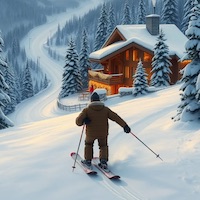 ‘Ski-ing downhill to a chalet … May I see that photograph? Thanks … to a chalet which has a perfectly good road past its front door.’
‘In the second break-in, Lauralee Yates—’
‘Another famous name.’
‘She’s in films. On 2 May 1955 this guy set off an explosion in the reconstructed fort, somewhere in the Pentlands, where the victim was working. Making a film about El Alamein. Overcame an armed security guard, despite apparently being unarmed himself.’
‘Was the guard hurt? Still above ground and breathing without assistance?’
‘The guard was in hospital overnight. When he came round, I spoke to him, but he didn’t seem to remember anything useful.’
‘Our man knows his unarmed combat, then.’
‘Absolutely. The third victim was Trudy Humphreys, stage actress, presently working in the Bevan Theatre in Glasgow.
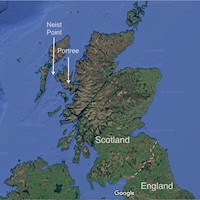 Now listen to this: On 2 November this year, she was a passenger on a small boat,
M. V. Cluaran an Luchd-siubhail,
registered in Portree and licensed to carry four crew and eight fare-paying passengers on pleasure trips close to shore.
Now listen to this: On 2 November this year, she was a passenger on a small boat,
M. V. Cluaran an Luchd-siubhail,
registered in Portree and licensed to carry four crew and eight fare-paying passengers on pleasure trips close to shore.
‘Do we know anything else about it? Who owns it? Who was the skipper? Who were the other passengers?’
‘Anything like that will be with the harbour-master or the owner. So we know only that Miss Humphreys was taking a pleasure trip which involved a night at anchor somewhere off Neist Point. In the middle of the night, our man appears to have dived 140 feet from the cliff into deep water and struck out to the boat. Boot-prints on the boat matched the ones on the cliff-top. Size Ten Hurberts. Talk about going equipped.’
‘Good Lord. So he’s some tough guy. It’s a miracle he’s still alive, even so.’
‘Alive, so far as anyone knows. And then there was the break-in into Catríona Murray’s room in the Grand Azure, last Saturday, the twenty-sixth. You know all about that.’
‘I wish I did. I’m still working on that one.’
‘But you haven’t heard the whole story. Here’s the strange part. None of the victims caught a glimpse of him.
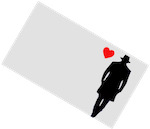 And he left his calling card and a box of chocolates where the lady would find it when she returned. Or in Miss Humphreys’s case, when she woke up.’
‘But by then—’
‘Exactly,’ said Ellis, ‘he was miles away.’
‘So he can turn his hand to stake-outs as well. What did the calling card tell you?’
‘Nothing. Blank with a printed silhouette and a heart.’
‘And there’s something else a bit odd. Chocolate was rationed until the fourth of July last year—’
‘A good choice of date,’ I said. ‘Children must have been running around eating their first liquorice allsort in five years and singing the National Anthem to celebrate Independence Day.’
‘I’m afraid Scotland hasn’t had its Independence Day yet.’
‘Pity, ’cause that’s a great day. How many sweets did they let you have?’
‘Two or three ounces a week. And you know the brand names. Carberry, Fyre, Marr, McInshott, Squaretree. Now, our miracle man leaves Chertsey chocolates for his victims. Chertsey. None of us has heard of it.’
‘Chertsey? That’s a leading brand in the U. S. Can I see one of the boxes that he left?’
‘There are a couple of empty boxes in the evidence store, and the business cards that were left with them. But of course…’
‘I’m ahead of you. Chocolate was still on the ration when the first two break-ins occurred. This guy risks his neck to give a lady a one-pound box of American chocolates. A month’s ration, in a good month. So, naturally, the ladies ate the chocolates, probably shared them with other people, so the chocolates wouldn’t have survived for long. All that evidence, eaten before anybody thought of telling the Police they’d been broken into.’
I picked up the manila folder and leafed through it. Photos, statements, couple of maps. Good for confirming everything you already knew about the case, but I didn’t.
‘Take it,’ Ellis said. ‘I’ll tell Jane that you’ve got it.’
‘Thanks. I need to go through all this,’ I said, ‘and then I need to think. But I can tell you one thing already.’
Ellis suddenly looked interested.‘Please do.’
‘There’s only one type of man who could have done all that. He’s a U. S. Marine.’
‘Very probably,’ said Ellis. ‘Very probably indeed.’
Ellis bought another paper cup of coffee and left the café. I watched him cross the road and disappear into the Police station. I noticed that he stood on the kerb and looked right first, then left, before he crossed. So I learned the secret. That was the reason the drivers hadn’t honked their horns, slammed the brakes on or run him over as he stepped off the kerb.
‘Behind these break-ins there’s a U. S. Marine,’ I said to myself as I finished the coffee, ‘or I’ll eat my hat.’

 Jane had told me that seven thirty was a good time to have dinner. At seven thirty, I was alone in the restaurant at the Sandringham, going over what I knew and trying to get the measure of it all.
The first thought that occurred to me was, maybe, this guy just enjoyed pestering ladies. These were all ladies that anyone who read the papers would’ve heard about. Or anyone who read Pure, or other magazines that shared the same model agencies. But the ladies never saw him. I guessed it was a
he,
although maybe it was a woman, driven to house-breaking by lust or envy.
He could have pestered them much more easily if he just banged on their doors, stared in their windows, wrote them letters, sent them bunches of roses, called them or stood outside the front window playing My love is like a red, red rose on the bagpipe. Instead he went to extraordinary lengths to reach them by the most strenuous and dangerous means imaginable, and then he kept out of sight.
A waitress in a neat black dress, frilly linen cap and an apron, came over to me and said ‘Good evening. Which room are you staying in?’
‘Gwil-lee-mott,’ I said, phonetically.
‘I mean the name of the room.’
‘Gwil-le-mott,’ I said again, phonetically, but slower.
‘Are you in Guillemot?’ she asked.
I thought for an instant. ‘Yeah, I think I might be. Get me a chicken sandwich with fries, cover it with slaw and hold the mayo.’
She looked a little flustered for a second. Then she gave me a menu, a single sheet of mimeo’d paper, ‘Have a look through tonight’s menu, sir, and I’ll come back and take your order. Would you care for a drink?’
‘Get me a Bud straight out of the ice-box.’
That flustered look returned for a moment. ‘The wine list is on the back of the menu, sir.’
‘Oh, I see,’ I said, ‘thank you.’
I stared at the Wine list, and I called the waitress back. ‘Hey! Is one of these a beer?’
‘I’ll fetch you a pint of draught bitter,’ she said, ‘unless you’d prefer a bottle of brown ale.’
‘Draught bitter sounds perfect,’ I said, despite not knowing what it was. I noticed the word chicken on the menu, and I knew what that was. ‘Here,’ I said, pointing to it, ‘may I have one of those?’
‘Yes, sir.’ She smiled, probably relieved that I’d understood something at last, she wrote it down and disappeared.
Then there were the boxes of chocolates this guy was handing out. Chertsey wasn’t on sale in Britain, yet this guy had enough of it to give away while chocolate in England was still on the ration. Scotland, not really England at all — glad that I wasn’t speaking out loud. But Chertsey was mass-produced, assembly line confectionery. Not hand-made, exotic or expensive in the least. Worth less than a dollar. If you wanted to impress a lady, you wouldn’t give her Chertsey. You’d spend five times as much and you’d give her Butler or ten times as much and give her Soubré Reserve. And there was nothing unusual in the boxes, or there was and nobody had told me about it: no jewellery, no drugs, no money. Just a box of chocolates that the lady could’ve bought with spare change at any corner drugstore.
I took a swig of draught bitter. Strange stuff. It had a flavour. I never knew beer could have a flavour.
I heard Jane before I saw her. ‘Sam!’ She was coming in the door, behind me. ‘I hoped I’d find you here.’ She came into view, all tight dress, high heels, short skirt and man-eating perfume. I stood up and she put her arms around me. I kissed her for a while. You have to kiss women who look that way and dress that way, because if they didn’t want to be kissed, they wouldn’t have dressed that way. ‘Want to buy me dinner?’
‘I thought you’d never ask,’ I said. ‘Don’t sit opposite me. Sit on one side where I can hold hands with you.’
She sat on my left as closely as she could pull her chair, and she picked up the menu. Half a minute later, my waitress returned.
‘You have beef on the menu,’ Jane said. ‘Angus or Argentine?’
‘We have some Angus left,’ said the waitress.
‘I'll have Angus beef, then, and if it’s all right with you, Sam, a bottle of the red burgundy and two glasses.’
I said, ‘Sure thing.’
Jane looked straight across at me and smiled that sunshine smile. ‘Don’t worry about the bill, Sam. You can put everything on expenses.’
‘Do you think I’d get away with that? ’Cause I don’t.’
‘Almost certainly, Sam, because I check the expense claims.’
The waitress retreated from view again.
Jane looked at me steadily. ‘What’s on your mind, Sam?’
‘These break-ins. Nothing about them makes much sense. Guy almost gets killed giving a very ordinary box of chocolates to a woman who makes headlines if she sneezes or she sweeps the floor. Doesn’t take anything and doesn’t talk to the lady. Leaves her a bit rattled, I guess. And then there’s the disappearing employment agency.’
‘You have to leave your work at work,’ said Jane. ‘Let’s eat and just enjoy being together. We could have a lot of fun.’
‘I kind-of hoped we would.’
‘We will. A lot, big boy.’
 We ate, we talked about anything but the case, and when we finished Jane asked if we could go for a joy-ride. ‘Let’s drive to The Puddles. I’ll point the way.’
‘What’s The Puddles?’
‘Nature reserve where nobody ever goes. There’s a place to park near the beach, and no street lights.’

 At about two o’clock in the morning we woke up, still naked and still lying together on the back seat of the car, still parked in the middle of a ring of tall trees and bushes at The Puddles.
‘How was I, Sam?’ Jane asked.
‘Perfect. The best ever, that cannot be improved upon. Tell me,’ I asked as I walked around to the driving seat in nothing but my underpants, ‘do you want to come back to the Sandringham with me?’
‘I’d been looking forward to it,’ she said.
‘Well, it’s two o’clock in the morning and there’s no traffic on the streets,’ I said as I felt in the darkness for my clothes on the floor of the car, ‘so how’s about I drive us back on the right hand side of the road? I feel more comfortable if the car’s the right way round.’
‘Great idea, Sam.’ I was so pleased that Jane and I agreed. ‘What this car really needs is a high-speed head-on collision causing deaths and serious injuries and all of it your fault.’
‘Fantastic. Let’s go.’
I turned the key in the ignition.
‘What?’ Jane shrieked, and then she paused for breath. ‘Stop! Stop!’ Sam, when I say “Great idea,” I mean the it’s the stupidest thing I ever heard.’
‘Why’s that stupid?’ I switched off the ignition and craned my neck right around, so I was looking straight at Jane. She was half naked still and I couldn’t have looked away even if I’d wanted to. ‘It ain’t stupid. There’s no traffic. At this time in the morning we won’t hit anything bigger than a milkman. Three hundred million Americans drive on the right every day and nothing bad happens to any of them. Except the ones who get killed in accidents, of course, but they ain’t driving the cars, they’re stepping out in front of them without looking.’
‘Sam, let me explain. In Scotland, when somebody says, “Great idea,” or “This pouring rain is just the right weather for a long walk in the hills,” or “Five pounds is a very reasonable price for a bundle of firewood,” they mean the exact opposite.’
‘How about when a woman says she loves you?’
‘That’s true. It’s your cue to say “I love you too,” or “Let’s go to bed,” or “Marry me.” ’
‘Are those the only options?’
Jane giggled. ‘I’m not sure, but… Yes, pretty much.’
‘Which one do you want to hear?’
‘It’s two in the morning or thereabouts. I want to hear you say, let’s go to bed.’
I turned the ignition key and I drove us safely back to the Sandringham, on the left hand side of the road the whole way. The roads were empty. We didn’t see another car.

I gave Jane a ride to the café opposite the Police station, drove around the block for ten minutes so that she and I wouldn’t be seen arriving together, and then drove back into the car park.
 As soon as I went inside, Jane called to me. ‘Morning, Mr Corsair! I got you a coffee!’ She handed me a paper cup of coffee and added quietly, ‘Remember, half past seven tonight is dinner time.’
‘I’ll be there, Jane,’ I said, ‘and I hope you will too. By the way, your perfume drives me wild.’
‘It’s Infatuation.’
‘It works on me.’
‘Are you infatuated with me?’
‘Completely and totally,’ I said, and Jane smiled.
Of all the things I’d seen and heard since I touched down in Scotland, the one that most troubled me was the overnight disappearance of
Spring Cleaning, Joshua Spring’s employment agency, and its sudden replacement by Happy Land and its — as far as I knew — sole member of staff, Chahrazad Sihème. Maybe Spring or Sihème had form.
Jane would know where to start. I picked up my reporter’s notebook and a pencil, and I went back to her desk by the public entrance. ‘Jane, have you got five minutes?’
‘I have all the time you want, Officer Corsair.’
‘Where’s the archive?’
‘Criminal records? Everything’s in the records room. I’ll show you where it is.’
The records room was a windowless, airless walk-in cupboard at the back of the station that stank of hot sweaty policemen needing to find pieces of ancient paper in an emergency. Jane pushed the plain wooden door open, showed me in and closed it again. Inside, she put her arms around me and gave me a passionate kiss.
‘It’s all in these filing cabinets?’
‘Aye. Thirty thousand records, alphabetically by surname. All you have to know is how to spell your suspect’s name. Good luck.’
Jane kissed me again and left. Maybe I really did mean something to her.
Less than an hour later, I’d found something.
SPRING, Joshua
32/4 Pearl Chare, Edinburgh 1
20 October 1942, Licensing (Scotland) Act, Found Guilty, Fine 4 guineas,
whatever they are.
20 April 1943, Licensing (Scotland) Act, Found Guilty, Fine 10 guineas.
Not much, but enough to see that someone called Joshua Spring lived on Pearl Chare, whatever that was, and had been dealing illegally in liquor. There was a newspaper cutting, with a handwritten note at the top, stapled to the card. Easier than writing up, I guess. The cutting was so dry and thin that I was worried in case it fell to pieces before I could read it all the way through.
The Scotsman 22/10/42 p. 5
48 BOTTLES OF UNTAXED WHISKY AND BEER
Last Tuesday, 20 October, one of the directors of J. S. Trading Ltd., Mr Joshua Spring, 22, of Pearl Chare in Edinburgh, pleaded guilty before the Sheriff Court to illegal trading in alcoholic beverages.
Constable Thomson, of the Lothian and Borders Police, stood in the witness box and testified before the Court that he had found twenty bottles of home made whisky, twenty eight bottles of beer and four of poitín in the basement of Mr Spring’s home. The drink was of uncertain quality and was to have been sold free of duty on the black market.…
Sheriff MacDougall ordered Spring to pay a fine of four guineas.
Constable Thomson could only be Detective Sergeant Ellis Thomson with thirteen more years’ service, so I had found a high ranking officer who could — probably — tell me a bit more about Joshua Spring. Maybe he’s heard of JS Trading Inc. Maybe he even knew what a
guinea
is.
Ellis told me that he remembered, if vaguely, charging Joshua Spring with unlicensed trading in alcohol early on in the War, and as far as he knew Mr Spring had committed a very similar offence a couple of years later, but a junior officer dealt with that. Since the end of the war, though, Mr Spring’s life had been unblemished, at least if you believed the Sheriff Court.
He went on to tell me that a guinea was worth one pound and one shilling. It was a high class currency used for the prices of furniture and race-horses.
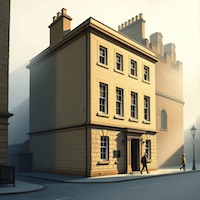 As for J. S. Trading Ltd., Ellis didn’t remember the company featuring in the case, and suggested that I try asking about it at Scottish Companies House. ‘They’ll tell you everything you don’t need to know,’ he said reassuringly, ‘and a lot more, if you don’t shut them up.’
‘Sounds just the sort of place I’m looking for,’ I said. ‘Where is it?’
‘I think it’s in Sole Cross,’ he said. ‘Jane knows the place. She’ll go with you.’
One very pleasant ride in the Jaguar later, Scottish Companies House did, indeed, tell us everything there was to know, and a lot more as well, about J. S. Trading Ltd. Their office was in Stranraer, a hundred miles from Edinburgh and a two-horse town, fishing and ferries. Joshua Spring had become a director of the company while living in Edinburgh in 1939, when all the other directors had begun work there in 1928, when the company was founded. Jane noticed another oddity. The company banked at Martin’s, while alone among the directors Mr Spring had declared his own checking account at Victory Holdings.
Knowing all this, we introduced ourselves to the Sherlock with the
Sumlock.
‘I do not know anything about this company that isn’t in its accounts, Mr Corsair,’ said the forensic accountant, John Rowe, ‘but it’s this sort of irregularity that keeps me in a job, so stay in touch — I need you. It looks to me like a forgery. Shall I tell you how it works?’
‘As long as the explanation is shorter than
War and Peace,’ I said.
‘I think it would be very useful to know how he did it,’ Jane smiled. How did anyone do a smile as devastating as that?
‘Mr Spring chooses a small company whose name, or something about it, appeals to him. In this case the company is called J. S., which happen to be his initials, but are also the initials of the managing director and principal shareholder, one Jowan Stainton.
Having picked a company, Mr Spring comes in here and picks up a form called
Notification of the Appointment of Director,
fills it in with his own name and address and the name and number of his chosen company—’
‘Ain’t no phone number on here,’ I said.
‘Not a phone number, Mr Corsair, but a company number, which appears on more or less anything that the company publishes. Then Mr Spring forges the signature of its managing director, who knows nothing about it.’
‘Then he gives the form to you,’ I said, ‘and you don’t notice that the form ain’t kosher?’
‘Sometimes we do, but this one’s slipped through the net. Every month we get hundreds of the things, and understandably we sometimes get a little bit slipshod. There isn’t time to scrutinise every signature and telephone every company head office to double check.’
‘So,’ I said, ‘what happens if nobody notices the fakery?’
‘Well, when the notification etc. is believed and accepted, we send a confirmation to Mr Spring and another one to the company, which telephones us if they notice anything suspicious. Except they don’t, of course, because its most junior employee picks the confirmation letter up off the doormat, looks at it, sees that it’s some sort of official communication that never tells them anything that they haven’t known for weeks, and tosses it into the dustbin. And as far as Mr Spring is concerned, objective accomplished. He can prove that he is a director of a registered company, even though—’
‘I get it,’ I said. ‘Why aren’t you a bit more careful? More suspicious, more stringent?’
‘Because we can only do those checks that the law requires,’ said Rowe, ‘and this law was made in 1856.’
‘In an age before fraud, theft and embezzlement had been invented. This country’s all history,’ I said.
‘And the story goes on. The purported new director takes the stamped and sealed confirmation into any bank he likes the look of, and he opens a business account. And with that, if anyone sends him a cheque, he can cash it. And that also saves him the embarrassment of having a pile of money hidden in a saucepan when the Police arrive.’
‘As we will,’ I said.
‘I rather think’ said Mr Rowe, ‘that’s everything this annual account tells you.’
‘We’ll arrive all right, but we won’t arrive yet,’ said Jane. ‘If we close his bank account, he’ll notice. He’s sure to go to ground.’
‘He already did,’ I said, ‘and our job is to do some digging.’

That evening, Jane and I were sitting together in my office.
‘Would you like to spend some time together in the Sandringham?’ Jane asked. ‘Tomorrow’s Saturday. We can stay in bed for as long as we want to.’
‘There’s nothing I want to do more,’ I said, ‘because I still haven’t recovered from the jet-lag.’
‘I’m pretty sure I can find something that will interest you,’ Jane said, correctly, ‘and you won’t need to get out of bed.’
Jane and I left the Police Station hand in hand, climbed into the car together and drove roughly in the direction of the Sandringham, but Jane thought it would be more relaxing for both of us if we parked on one of the paths across Queen’s Meadow and worked off some passion in the back seat.
‘Your head is still full of fake telephone numbers, disappearing offices and a strange man who leaves boxes of chocolates for women he’s never met,’ Jane said. ‘I know how to take your mind off all that and let you see the job in perspective.’
Gently, whispering ‘This time, leave it all to me,’ she made love to me. After that, Jane seemed more important than the job. There would be other jobs. At least, I hoped there would be other jobs, but there would never be another Jane. I wondered where she gained her extraordinarily detailed knowledge.
‘I’ve never read so much as a self-improvement book on how to do sex better,’ she confided.
‘You could write it,’ I said, ‘and you’ll be on the front page of the
TLS
by this time next week.’
‘No, I couldn’t. I just… I just love you. The rest all comes by instinct,’ she smiled, ‘and anyway, you can do it too. Nobody ever made me feel so happy, safe, good.’
‘Are you serious? You know I’m an old man, tired and weak.’
‘No,’ said Jane, ‘but if you sing the verse, I’ll join in the chorus.’
‘What? Can you explain?’
‘I mean you’re fifty and you’re the best I’ve ever had.’
We sat on the front seat on the car and we held each other close. We drove off towards the Sandringham.
That night, in bed, reassuring me, Jane told me again that she loved me. Nobody except my mother had ever told me that before. I held Jane close. Strange to say, it wasn’t the lust that made me feel so calm and happy. It was that sense of being close, joined together, that I don’t think I ever felt before.
 Jane decided that I should see some of the sights of Edinburgh while I was working there.
‘Heads or tails?’
She flipped an imaginary coin, caught it on the back of one hand and covered it with the other. I called ‘Heads.’ Jane uncovered the coin and told me we were going to spend the morning in the castle, and ‘The Loch Ness Monster can wait until tomorrow.’
‘How many times have you seen the Loch Ness Monster?’
‘She keeps herself to herself,’ said Jane. ‘I’ve seen her, but only in faked photographs and once I heard her on sonar — and even that was on the wireless.’
I could scarcely believe what Jane was telling me. ‘The Loch Ness Monster is a lady?’
‘Definitely. Probably the most powerful lady in the whole of Scotland,’ Jane smiled, ‘apart from the Queen, of course.’
We spent about two and a half hours looking around Edinburgh Castle. I never saw such a handsome Army base and housing estate, with a fine view of the sea in the distance. Mind you I couldn’t see how a tank battalion could have got out through that narrow arch.
‘The inlet there is a natural harbour,’ said Jane, pointing into the distance. ‘See? A hundred years ago, the water would have been bristling with the King’s ships.’
‘Going where?’
‘Wherever they were needed. All over the world. Australia, India, Africa, South America.’
 We walked through the gate, out of the castle, downhill towards the city.
‘Gosh,’ I said, ‘you mean, this castle is pre-war? Pre-first world war?’
‘Sam,’ Jane explained with a broad grin on her lips, ‘this castle is pre-America.’
‘Shouldn’t they have build it nearer the stores?’
‘Well…’
We heard a sudden, tremendous, explosion behind us, like a grenade going off.
‘Gunfire!’ I yelled, as the bang echoed around us. I threw myself onto the sidewalk, grabbing Jane’s arm so as to pull her off balance. If she was standing up, she was a target. She landed beside me. ‘Roll away from the traffic,’ I yelled, ‘you’ll be safer if you lie close to the wall. And don’t move.’
A moment later, I noticed that nobody else had ducked out of the way, and I yelled, ‘Get down! Get down, people!’
‘We’re perfectly safe, Sam,’ Jane said. ‘and so is everyone else. Help me up.’
‘We’re under fire, Jane. Don’t you know what that means?’
‘It means you don’t know about an old Edinburgh tradition, Sam. Here, help me up.’
‘We’ll be shot.’
 ‘Sam, it’s the one o’clock gun. It’s the cannon that you were looking at half an hour ago.’
‘Was I?’
‘It’s not aimed at you, nor at anybody else. They fire that gun on the stroke of one o’clock.’
‘Oh,’ I said as realisation dawned on me. ‘That gun.’
I stood up, grabbed Jane’s arm and pulled her upright.
‘Are we a long way from the car?’ I asked. ‘My clothes got a bit dusty. If we went to the Sandringham, I could give them to the laundry and change into a clean outfit. While I’m there, I shall wipe the egg off my face.’
‘I’m not surprised that you got dirt on your clothes,’ Jane said. ‘I got some mud on my coat, too, and some bruised ribs as well. We’re not far from the car. We’re on the Royal Mile. Lots of little shops all crowded together. The car is a couple of minutes’ walk away, but I think you need to sit quietly for a couple of minutes before you get behind the wheel.’
‘Yes,’ I said, ‘I need to relax. I’m still shaking. I must have looked a fool.’
 ‘Oh, look on the bright side.’ Jane squeezed my hand. I turned towards her and she kissed me. ‘You showed everyone what to do if a gunfight starts. That could save someone’s life, especially if the English invade. Why don’t we sit in that coffee-shop over there and cool off a bit.’
‘Do they have Viennese coffee?’
‘Quite possibly. They might even sell Coca Cola. There’s only one way to find out.’
We sat together in a dimly lit corner. Jane went to the counter and asked.
‘They have both,’ Jane reported back. ‘Viennese coffee and Coca Cola. It’s a miracle. Somebody tell His Holiness.’
When I took a first sip of the coffee, I felt better already. ‘Jane,’ I asked her, ‘do you really think the English are going to invade?’ I asked.
‘I’d say it was unlikely, as they haven’t invaded Scotland since the middle of the sixteenth century, but it always helps to rehearse. You’ve shown me what to do if they return and charge the crowds on horse-back with banners waving and swords lashing out. I know what to do if they open fire.’
‘Practice makes perfect,’ I said.

We left the café and we walked farther down the Royal Mile. I looked along the line of small shops opposite and I noticed one called
International News.
‘Do you think they might have
The New York Telegraph?’ I asked Jane.
‘Are you homesick already?’
‘No, but I want to know who won the hockey game.
If the Rangers won, then I can pay the phone bill.’
‘Well, looking in the window, I can see they have
Le Monde, Der Spiegel, Pravda and something in squiggly writing that I can’t read, so it looks worth trying.’
 They say you only know there’s a God because of the co-incidences.
Inside the shop, four or five customers were browsing the newspaper racks. At the back of the shop, bringing in some cartons through a back door, was the man I most wanted to talk to. He was looking now at the carton he was shifting, now at whatever was on the other side of the door. If they’d let me have a gun, I would have drawn it. I was lucky. So far, he hadn’t recognised me. And he probably didn’t have a gun either.
Behind the counter, the shopkeeper was a man who might have been sixty years old. Grey hair, grey moustache, short and stocky, pale brown overalls. Like everyone in the newspaper industry, he was unshaven and he had likely been awake since midnight, receiving the latest papers and setting them out on the racks. Just by looking at him, you could see there was nothing about the newspaper business that he didn’t know by heart.
‘Jane,’ I muttered, ‘can you create a diversion?’
‘When? Now?’
‘Yeah. Distract that guy at the back of the store. I want to see his face, and I don’t want him to notice mine. Get him to look at you. Go for it.’
‘Certainly, Sam,’ she said, smiling. ‘I have an idea. I’ll take all my clothes off. How would you like that?’
‘I’d like it a lot, but can you think of another idea, instead?’
‘That may take a while.’
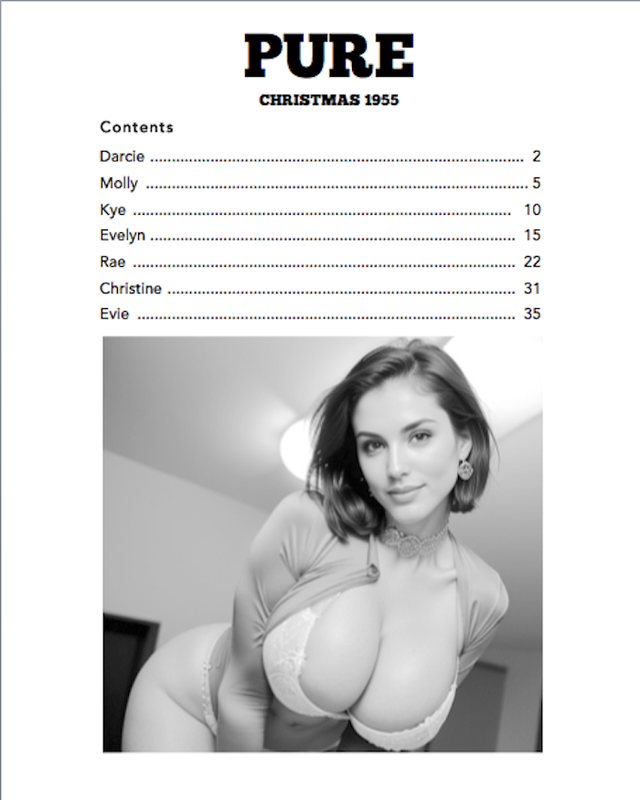

Jane walked up to the counter and asked the shopkeeper, in a voice loud enough to be heard on Mars, ‘Is the Christmas issue of Pure in yet?’
‘Everybody looked at Jane as the shopkeeper picked up the magazine from behind the counter and put it down in front of her.’
‘Do you mind if I look at the centrefold? Just a look and then I’ll give it back. They’re always so beautiful.’
‘The public library is on Mountbatten Bridge,’ said the old man, who was obviously used to being mistaken for Freebie Central. ‘In here, that magazine costs one shilling.’
Jane, who had several shillings in her purse and would have claimed the magazine on expenses anyway, protested noisily. ‘I only want to look at it!’
We had a diversion in progress. It was most effective.
Jane picked the magazine up and made a feint of trying to open it. The shopkeeper snatched it out of her hands. Then, in a masterpiece of improvised theatre, Jane gripped her left middle finger in her right hand and yelled blue murder.
‘Aaah! That’s the finger I dislocated! You—’
‘Sorry. I didn’t mean to hurt you. Just defending the shop’s property.’
The ruse worked. The man at the back of the shop was watching the argument open mouthed. I saw his face clearly. Joshua Spring. Mr Spring recognised me, dropped the carton in a crash of shattered glass, wheeled around and disappeared through the open back door. That’s what happens if you don’t have a gun.
Jane was clutching her finger and wailing in agony.
‘Here,’ I said to the shopkeeper. ‘I’ll pay for the damage.’ I had no idea what a shilling looked like, so I took all the coins out of my pocket and held them out to him in the palm of my hand. ‘Is any of these a shilling?’
He found a silver coin and took it.
‘That guy who ran out the door,’ I said, ‘is that Joshua? I think I know him.’
‘Joshua Spring.’
‘Yeah, that’s the man. He wrote to me recently and told me that he’d found a job. This must be the job he found,’ I said.
‘You know him?’ the shopkeeper asked.
‘Oh, we met a couple of days ago.’
‘He’s
on the lump,
’ said the shopkeeper. ‘He’ll work here, cash in hand, for a few weeks. Then he disappears and two or three months later, he comes back.’
‘I’d like to see him again before I go back to the States.’
Jane was still clutching her finger and yelling, so I said, ‘That’s a bad injury you’ve given yourself, honey. I’ll give you a ride to the
E. R.’
The shopkeeper told me what I already knew. ‘It looks to me as though Josh doesn’t want to see you.’
‘It’s a long story. If you wanted to find him, where might you look?’
There was a handwritten note pinned to the wall. The shopkeeper turned around, pulled the note off the wall and gave it to me.
‘One of these places,’ he said.
‘May I borrow this?’
‘Of course.’
‘And do you have the New York Telegraph somewhere?’
‘Over there. Half a crown.’
‘Half a crown?’
‘Yes, sir. Air freight is pricey.’
‘Oh, I’m not complaining about the price. I’m asking what half a crown means.’
Again I took all the coins out of my pocket and offered him the choice. He took two coins, put them into the cash register, and put three coins back into my hand, saying,
‘One and six change.’
I found the paper. ‘Come on, Jane, you’ve suffered enough already. I’m parked outside. I’ll take you to the hospital. Hope you’ve got Blue Cross.’
‘I take it everywhere I go,’ she said, ‘despite not knowing what it is or what it’s for.’
We left the shop together. Jane stopped clutching her finger. ‘It’s all right, Sam, I was faking it. You asked me to create a diversion—’
‘You did good. Grace Kelly herself couldn’t have acted better.’
We sat in the car and I leafed through the newspaper.
Jane asked me, ‘How did the Rangers get on?’
‘I don’t know,’ I said. ‘This is Tuesday’s paper. Half a crown wasted, whatever that is.’
‘Thirty-five cents,’ said Jane.
‘Do they have tax deductible investments in Scotland?’ I asked.

 We were in the Sandringham. We spent a warm and loving night, and we awoke in each other’s arms, holding each other close. The sun was rising. In this part of the world, that’s about nine o’clock.
‘Morning, lover.’ Jane’s voice was a perfumed whisper. ‘Want to make love again?’
‘That’s the best idea I ever heard,’ I said.
When we awoke, the day outside was bright and looked cold. I wasn’t sure that I could untangle myself from Jane. I only wanted to cling to her.
‘Here,’ said Jane. ‘This is what I bought in
International Newsagency.
I thought it might interest you more than the
New York Telegraph.’
The December issue of Pure was on her bedside table. She reached it to me.
‘Why would I want this, when I have you?’ I asked as I struggled to sit up and look at it. ‘This is for when you’re desperate for a girlfriend and you haven’t got one.’
‘You want it because you like looking at pretty ladies. Don’t be afraid to admit it. I’d much prefer a boyfriend who likes to look at women to one who doesn’t. Besides, look at the front cover.’
‘Should I recognise her?’
‘Yes, because she’s Catríona Murray. So there are probably pictures of her in there somewhere.’
I opened the magazine at random and I saw pictures of a woman who wasn’t Catríona Murray.
‘She’s beautiful,’ I said.
‘See? I told you that you like looking at pretty ladies. Is that Catríona?’
‘No,’ I said. ‘I met Catríona. I’d recognise her. This is Salomé, at least according to the caption.’
‘You should look at Catríona because she’s one of the victims of the break-ins.’
‘OK,’ I said, ‘let’s see whether we can learn anything from her photos, other than what she looks like with nothing on.’
I turned to the contents page.
|
The Girls
|
|
Bathsheba by Rhoda Wright
|
page 6
|
|
Salomé by Jacob Glover
|
page 9
|
|
Catríona by Christian Rose
|
page 10
|
|
Candace by Rhoda Wright
|
page 22
|
|
Amethyst by Rhoda Wright
|
page 24
|
|
Tiffany by Christian Rose
|
page 30
|
|
Susanna by Jacob Glover
|
page 38
|
|
Honor by Candace Yates
|
page 43
|
 So I turned to page 10, and there was Catríona. She was pictured in a bikini on a yacht, in her hotel room wearing a negligée and in her underwear in front of a diorama, a featureless coloured wall which could be found in pretty much any photographer’ studio.
Jane took a look at her and said, ‘Have you ever kissed a woman with that much lipstick?’
‘No,’ I said, ‘I don’t think so.’
‘Do you like kissing a woman who’s wearing lipstick?’
‘Yeah,’ I said. ‘Yes. It feels nice.’
‘I brought some tulip red Elizabeth Arran,’ said Jane. ‘We’ll enjoy that together.’
‘I still have to scour this magazine for evidence,’ I said, ‘starting at the beginning.’
‘That’s all right,’ said Jane, ‘as long as you don’t pretend that you aren’t enjoying it.’
I looked at the front cover again. Then I opened the magazine and I saw the contents page again.
‘Eight ladies, listed in no order that I can see, and probably all with fake names,’ I said.
‘Let me see.’
Jane wriggled across the bed so that she could look at the names of the women.
‘Well, now,’ she said, ‘look at that.’
‘What have you noticed?’
‘The name’s the same. Tiffany. One of our victims is called Tiffany.’
‘Lots of women are called Tiffany,’ I said. ‘She ain’t necessarily the same one.’
We turned to page 30. There was Tiffany: older than Catríona but not much, long black hair, sultry, the girl who lived in the leafy suburb and always came top of the class. She posed in a dress store, in what looked like a hotel lounge, and on the inevitable yacht.
‘Want to know what I think?’ I asked Jane.
‘You’re thinking that it’s the same yacht.’
‘You’re right.’ As I looked at the pictures, the obvious dawned on me. ‘It is. The light, the contrasts and the shadows, are the same, so the pictures were taken at the same time of year. And look at the scenery. That’s the same, too. Same yacht, same place.’
‘Same photographer,’ Jane put in. ‘Christian Rose.’
‘I bet he doesn’t mind getting up and going to work in the morning.’
‘Does all that tell you anything?’
‘It tells me the same as it tells you, Jane. Two of the victims, Catríona Murray and Tiffany Walters, were on the same boat at the same time, posing for a photographer called Christian Rose.’
‘Anything else?’
‘I’ll bet the farm,’ I said, ‘the boat was the M. V. Clu… something or other.’

|
|
Jane’s granny shoots a tin of beans off a fence-post
|
Jane filled in the missing words for me. ‘Cluaran an Luchd-siubhail. It means
Rusty Bathtub.
‘Really?’ I asked. ‘Somebody called his yacht the Gaelic for…’
‘No, not really,’ said Jane. ‘It means The Traveller’s Thistle.’
‘Where the devil did you learn that there Injun talk?’
‘Inherited privilege, Sam. My granny came from Harris. She never spoke a word of English.’
‘Did she wear a feathered head-dress and cut the heads off neighbouring tribes-people with a tomahawk?’
‘No, she spent most of her time cutting peat and tending potatoes, but she was a crack shot with a bow and arrow. She could shoot a tin of beans off a fence-post from a hundred yards.’
‘How about two hundred?’
‘Harris isn’t that big.’

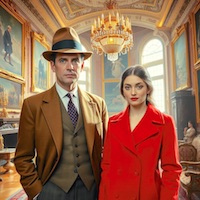 Jane suggested we have a look at the passenger manifest of the M. V. whatever-it-was and see who else was on it. If the vessel was abiding by the law, the master of the vessel — how I loved the antique language of Scottish maritime law — would have left a list of his passengers and his route at the harbour-master’s office in Portree. That wouldn’t tell us who the crook was, unless he’d signed it with his real name and paid the fees and charges with Diner’s Club, but it might tell us who the victims were. The fly in the ointment was that the only place where that list could be found was the harbour-master’s office in Portree, getting on for three hundred miles away to the north, in a country with a famously inhospitable north.
‘Three hundred miles,’ I said, ‘that would be five hours or so on the freeway, wouldn’t it?’
‘Freeway?’
‘Yeah. A place that far away, there has to be a freeway — right?’
‘Well… not really. We won’t get to Portree on a Sunday,’ said Jane.
‘The Wee Frees
would be absolutely boiling under the collar if we could. The Highlands are closed on Sundays, including the buses and the ferries.’
‘How about the car hire firms?’
‘That’s an excellent idea, but they too are as shut as a Sunday school on Wednesday, I’m afraid.’
‘So,’ I asked Jane, ‘how are we going to get there, and when?’
Jane had a great gift for geography. ‘We can go tomorrow.’
‘Monday.’
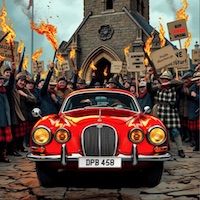
|
|
What happens when the Wee Frees see someone driving a car on Sunday
|
‘Yes. Train to Kyle of Lochalsh, then there’s a ferry-boat to Kyleakin, and after that there’s a bus to Portree. I'll book a double room for two nights at the Duke’s Hotel.’
‘Won’t the Wee Frees be annoyed about the double room?’
‘They’ll go berserk,’ Jane laughed, ‘just wait and see. They haven’t even got over the Duke’s selling alcohol. Meanwhile, how would you like to spend today seeing the Queen’s house in Edinburgh?’
‘That would be better than working,’ I said, ‘if the house is open and especially if we can drive there. Let’s do that.’
‘Okay, big boy, but don’t let the Wee Frees catch you driving a car on the Sabbath day,’ Jane advised.
‘Do they station a battalion here?’
‘No,’ said Jane, ‘they start at about Perth.’
We wandered through Holyroodhouse for three hours. I was very impressed. I’d never seen anything like the sheer beauty of it.
‘Those rooms… I’m sure Eisenhower’s envious,’ I said as we left. ‘Kings and queens must have been really, really important.’
‘Of course the Queen’s important,’ Jane explained, sounding a little more irritated than I thought necessary, ‘She’s the Queen. She’s the most important person in Scotland. That’s what “Queen” means.’
‘That’s why you don’t need a president, I guess. The place is so old, I wonder it hasn’t fallen down.’
‘We look after it, Sam. The Queen needs a place to live when she’s here.’
‘And it’s so big. A huge place.’
‘They built outwards because they couldn’t build upwards. The electric lift wasn’t invented until 1852.’
‘How do you know all that?’
‘School project.’ Jane smiled at the memory of her attempt at architecture appreciation. ‘When I was about ten, the school made us write two pages about Holyroodhouse. I remember it took ages. I borrowed the guide-book from the library and copied it until I’d filled two pages and I had sore fingers afterwards. I got six out of ten.’
‘Six out of ten — way to go!’
‘Not really. It’s a fail mark.’
We were driving back to the Sandringham, along Laurence Street, and Jane was telling me that she didn’t want to live in a house like Holyroodhouse because she didn’t want to be endlessly surrounded by fawning servants, and I was telling Jane that I’d bet the farm she’d live there if the chance came her way, when the knob came off the gear-shift. A minor problem but, fortunately as it happened, it needed to be fixed, so I pulled over to the kerb. I spent a couple of minutes trying to screw the knob back onto the stick, but the thread was cracked and I couldn’t get it to stay in place.
I explained the problem to Jane and I asked her whether she thought it was safe to drive the car.
‘Probably,’ she said, ‘but there’s a shop over there that sells car parts. Why not ask them if they can replace it?’
‘On a Sunday? What will the Wee Frees say?’
‘There’s an “Open” sign on the door, and the Wee Frees are all in Church because it’s the Sabbath day, so be quick and leave before they find out and surround the place.’
‘Where is the shop?’
‘Two doors along.’ Jane pointed. ‘Green paint.’
‘Give me two minutes.’
I wandered over to the shop. It was small, one door and one plate-glass window, and painted above the window,
Fix A Car in yellow lettering. Hard to get spare parts our speciality.
When I looked in the window, I saw a lady I recognised. She was tidying up around the counter and the cash-till.
I came back to Jane’s side of the car. She sensed — by Police instinct, I guess, or maybe I already had that expression of grim determination on my face — that something was up.
‘Jane, tell me,’ I kept my voice down, ‘how much Police training have you had?’
‘The minimum. I’m a Special. I can look after myself, blow a whistle, arrest people and stand on the touchline of a football match looking out for anyone throwing an empty beer bottle.’
 ‘Anything else?’
‘No, that’s it, except that I used to watch Here Come the Rozzers on telly.’
‘That’ll do me. You and I are partners for the duration.’
‘Oh. Wonderful. What are we going to do?’
‘Keep out of sight and stand by the gate,’ I said. ‘The back doors of the shops along here lead to that gate. If a woman comes running out, get her into the back seat of the car. If she’s who I think she is, she and I ought to have a little chat.’
‘Yes, sir. I’ll change into Super-rozzer immediately. Just one thing, Sam, supposing she isn’t who you think she is?’
‘Then I buy a new knob for the gear shift, pay three and sixpence and wish her a pleasant afternoon.’
‘Three and sixpence?’
‘I agree it’s only worth fourpence halfpenny, but she has to make a living.’
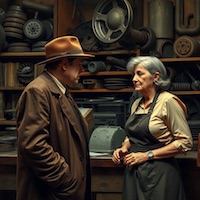 A bell tinkled as I opened the door of Fix A Car. It was a dim and dingy place with dusty boxes of parts on every hand, and most of them looked as though they had been there since before the War. The shopkeeper turned to look at me, and I asked if she had a gearstick knob like the one I was holding.
‘Ford Prefect,’ she hazarded.
‘Close, but no cigar,’ I said. ‘Jaguar Mark One.’
‘You’re a man of taste.’ She turned around and reached into a cardboard box on the shelves behind her.
‘Three and sixpence.’
‘Thanks.’ I fumbled for the coins. ‘Don’t I know you? Aren’t you Chahrazad Sihème? You worked at Happy Land on Moray Circus.’
‘Sorry, you’re mistaken. I’m Mabel Thorp, and I’ve never heard of Happy Land.’
‘I’m a Police officer, Mrs Thorp. L. B. P. D.’ I showed my warrant card. ‘Mind if I take a stroll around?’
‘It’s a bit scratched, this knob,’ she said. ‘By all means look around. Maybe I’ve got something else that you need. Meanwhile, I’ll see if I can find a knob in better condition than that one.’
I felt the draught of cold air as, I guessed, the woman opened the back door. After half a minute of looking around half-heartedly for something that didn’t belong, I heard Jane shouting, ‘Police.’.
Miss Sihème gasped, ‘Oh, gawd!’
‘Everything’s all right,’ Jane continued, ‘but please spare us five minutes. We’d like to talk to you.’
When I turned up, Jane and Miss Sihème were standing together perfectly peacefully beside the gate.
‘Good work, partner.’ and then ‘Mabel Thorpe, I’m officer Corsair and my partner is Jane, er…’
‘Tiptree,’ said Special Constable Jane Tiptree.
‘Tiptree,’ I repeated. ‘I’m officer Corsair and my partner here is Jane Tiptree. Would you get into the back seat of our car, please? We want to talk to you.’
‘I ain’t done nothing.’
‘We know,’ I said. The last thing I wanted was for the lady to panic. ‘Everything’s fine and dandy.’
The woman was surprisingly obliging. She happily sat herself on the back seat, Jane sat beside her and I sat in the driver’s seat, twisted around to talk to her.
‘Now, lady, we need to ask you a couple of questions. Starting with, are you Chahrazad Sihème, or Mabel Thorp, or someone else?’
‘I’m Eunice Charlton. Mabel Thorp is made up. Here, I think I’ve still got me identity card in me pocket. It’s old now, but it’s still mine.’
She had. The card had been issued at the outbreak of war. It was worn and crumpled, but clear as day. Mrs Eunice Anthracite Charlton, 15/2 Timberwood, Leith.
‘Thank you. You’ve kept the card in remarkably good condition. Now, a day or two ago, you were working in an office on Moray Circus for a business called Happy Land.’
‘Yes. I get sent all over. A man called Colonel MacCall sends me letters telling me where to go. He owns a few small businesses in town, six of them, I think. I do a bit of this and a bit of that for ’im. ’E doesn’t like me to use the same name in different places, so I uses me imagination.’
‘Why did you lie about the address?’
‘Colonel MacCall tells me to use a false name any time he sends me to work. He doesn’t want people to follow us around. See, I didn’t know you were a Policeman.’
‘What does Colonel MacCall write in these letters?’
‘Where I’m to go, what days and times, what to do when I get there. He pays two and nine an hour. That’s good money in Leith, and I get work three weeks out of four, I’d say.’
‘Do you have one of the letters, by any chance?’
‘Not here,’ she said, ‘not on me, but maybe in the shop or at home.’
‘If you find one, or you get another one, could you drop it in to Greyfield Square Police station?’
‘Of course. Of course I will.’
‘Suppose I wanted to get in touch with this Colonel MacCall,’ I asked, ‘where would I find him?’
‘
M. P. S. 40,’ said Mrs Thorpe, ‘No street, no phone number or nothing, just Colonel MacCall, M. P. S. 40. That’s all I know.’
‘Thank you, Mrs Charlton. If we need to speak to you again, we’ll find you somewhere. We’ve covered everything we need to for now, haven’t we, Jane? I mean, W. P. C. Tiptree?’
I got out of the car and opened Mrs Charlton’s door.
‘Three and six,’ she reminded me. I had three shillings and two threepenny bits in my coat pocket, so handing it over to her was, if not easy, then at least possible. Half crowns, bobs, florins, tanners, there was a whole language in the money alone. How anyone actually bought anything with it, I couldn’t imgine.
After Mrs Charlton had gone back into Fix A Car, Jane asked me where M. P. S. 40 was.
‘Military Postal Service,’ I said. ‘Means it’s a secret posting, like B. F. P. O., only with American mail. The places are classified. M. P. S. 40 could be anywhere in the world.’
We were two steps forward and one step back.

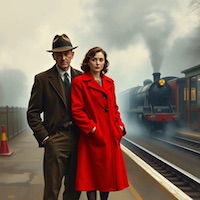
|
|
Kyle of Lochalsh station
|
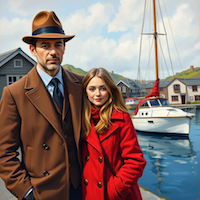
|
|
Portree harbour
|
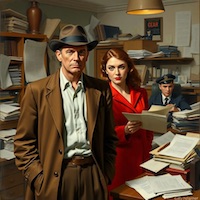
|
|
The harbourmaster’s office
|
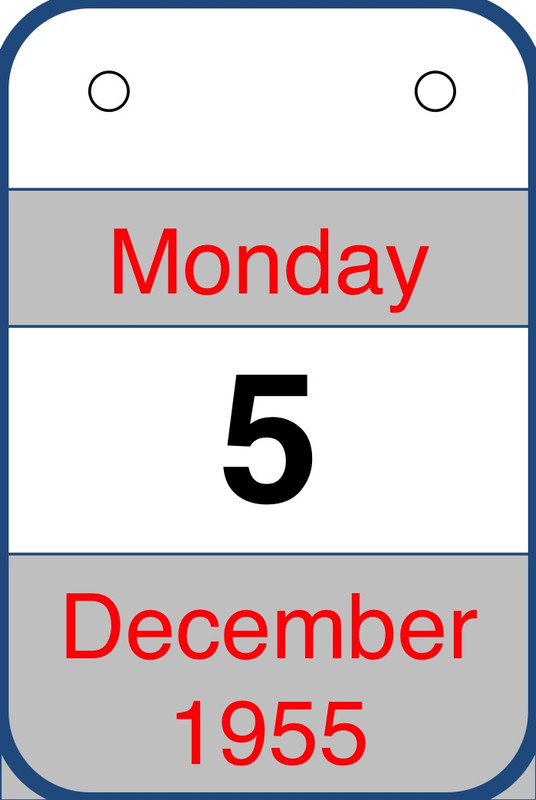 We left the hotel early on Monday, carrying the paperwork, a change of clothes, toothbrushes and two picnic hampers which with her foresight born of experience Jane had ordered from the hotel kitchen. I suppose we could have driven all the way, but Jane knew there were no freeways here. The roads were bad, narrow, winding, and many of them, lacking a tarmac surface, turning to slippery rivers of deep mud whenever it rained. We braced ourselves for a long journey and found a first class compartment on the train from Union Station on Princes.
The train was out of Edinburgh and rattling through open countryside in no time flat. Two or three miles, perhaps. We would be on one train or another for a few hours, so maybe it was a good time to go over what we knew about the crime we were investigating — that’s if it really was a crime.
‘So where has yesterday’s adventure left us?’ Jane asked.
‘That’s just what I was thinking. A bit further forward, I’d say. One, somebody called Colonel MacCall owns some small businesses in Edinburgh. He swaps the personnel around. I saw bootleg liquor in International News, and in Fix A Car Mrs Caprice gave us an idea of how MacCall operates. MacCall’s address is an M. P. S. number, so it’s classified. You’re not supposed to know where he lives. Two, a few months ago, two known victims of the intruder were sailing on a joyride round the Hebrides, details of which may be in the office of the harbour-master in Portree. And Three, your second name is Tiptree. I’d never have guessed.’
‘I’d say we were making slow progress,’ Jane surmised. ‘What about the house-breaker himself?’
‘He — or she — might be linked to the here-today-gone-tomorrow shops and offices,’ I said, ‘but that’s just a possibility. He might not be. Our only eye-witness says she saw him in a hotel room where one of the victims was staying. How he chose his victims and why he leaves them Chertsey assortments still puzzle me.’
 Jane was suddenly alert and looking keenly out of the window.
‘Sam! Look now, or you’ll miss it. You’re going over the Forth Bridge. The most famous bridge in the world. A mile and a half long.’
‘The fourth bridge? Did I miss the first, second and third?’
‘Yes,’ Jane told me, ‘but don’t despair. I’ll make sure you see them on the way back.’
 As you would expect in the depths of winter, The Duke’s Hotel was three quarters empty. We arrived around nine in the evening, just before last orders, when the crew in the kitchen were hoping that there wouldn’t be any more customers arriving and they could pack up and go home early. Sitting around us at the polished wooden tables in the bar drinking Rìoghail whisky or Aulder’s beer were a man in a suit and tie who was probably a representative selling whatever he sold to the enterprises of the town, a couple of men in grey tweed overcoats and homburgs who might have been locals passing the evening in front of the peat fire, a couple who looked like man and wife in Portree for a winter holiday, and two young men in what looked like khaki Army fatigues. I guessed they might have been commandos or Special Service — tough guys if ever there were any — recovering from exercises in the Cuillin Hills. From what I had seen, the hills looked as demanding a territory as any army could have ordered its crack troops to survive in.
Jane and I spent our evening eating the restaurant’s excellent dinner, and our night wrapped around each other in bed.
 We were on the quayside in Portree Harbour a few minutes after the harbour-master’s office opened for business.
The harbour-master’s office was a well-worn terrapin building, strikingly similar to the pre-fabs that had been put up near bombed-out houses all over the south of Scotland, apart from the wooden sign near the front door. Harbour Master. All vessels report here.
The harbour-master was a happy man of around thirty, who wore the peaked cap that went with the job over a ribbed navy blue sweater and grey uniform trousers. He arrived a few minutes after we did, unlocked the door to the small brick hut that was his office, and told us breezily in a Gaelic accent, ‘Maduinn mhath…
Are you waiting for me? Come on in. I’m the harbour-master, Master Mariner Harry Byrne. How can I help you?’
‘L. B. P. D.,’ I said, holding up my warrant card. ‘We’re Police officers. We’d like to see any documents concerning the M. V.— what’s it called, Jane?’
Jane found her warrant card, held it up for Byrne to look at, and then filled in for me. ‘M. V. Cluaran an Luchd-siubhail.’
‘Thank you,’ I said.
‘It’s a fifty foot Waveseeker yacht licensed for eight passengers and four crew in inshore waters. Gets hired often by tour companies. It sails with the same crew every time. It comes and goes a lot, sails around the Western Isles, but just at the minute it’s over there.’ Mr Byrne pointed to an expensive looking yacht moored at the far side of the harbour. ‘It got into some sort of difficulty a year or so ago, I remember. It’ll all be in the files. Those two grey cabinets, and the vessels are in alphabetical order. Spend as long as you want looking.’
Jane said,
‘‘Tapadh leibh.’.
‘What letter does the name begin with?’ I asked.
‘C,’ said Jane. ‘I’ll look for it.’
Jane opened the top drawer, A–E, and pulled out the manila file for the yacht. The yacht appeared to have been busy, because the file must have contained at least fifty of the forms that logged its passenger list and itinerary. I thumbed through them in the hope of finding some record of the difficulty that it had found itself in.
To one of the forms, someone had stapled a newspaper clipping and a handwritten note.
‘Man overboard,’ I read aloud.
‘That’s not unusual,’ said Mr Byrne, ‘people fall off yachts all the time. The crew dealt with the incident correctly, no-one was hurt, and the yacht came straight to the nearest harbour. The company that hired the yacht arranged another trip to the same places two weeks later.’
‘Was anyone we know on board the first trip?’
‘I wouldn’t know,’ said Mr Byrne, ‘but do have a look. The passenger manifest is right there.’
Jane looked across at the M. V. Cluaran an Luchd-siubhail on the far side of the small harbour. ‘I think there’s someone working on the yacht.’
I looked. There was a man carrying a crate up out of the yacht and along the harbour pier. I guessed he was removing the garbage from his last trip and making way for fresh stock.
‘We should go and talk to him,’ I said. ‘May I take this document with me, and the one about the second trip?’
‘No,’ said Mr Byrne, ‘I’m sorry for the inconvenience, but the folders mustn’t leave this office. If it helps, I’ve had a
thermofax
installed,
so I can copy them for you. Come back in two hours and I’ll have copies ready.’
Jane and I looked at each other with trepidation. We had no plan, no search warrant, no gun, no uniforms and a Judge might even say we had no reasonable grounds for suspicion as he packed us off to the calaboose. Yet when Jane said, ‘Opportunity only knocks once, Sam,’ she was right.

Jane and I stood outside the harbour-master’s office in Portree watching a man — we had no idea who he was — carrying boxes out of the fifty foot yacht
M. V. Whatever-it-was,
moored alongside the pier, and stacking them on the quayside. I counted them and I got to eighteen.
With the harbour-master watching us from the hut on the quayside that served as his office, we walked to within hailing distance of the yacht. The man seemed engrossed in the boxes and didn’t notice us.
The man was climbing up the stairs from below deck, bringing another box up, carrying it on one shoulder. It looked heavy. We raised our warrant cards, rather in the fashion of Olympic athletes raising the medals that they’d just won, and I said, ‘L. B. P. D.’
Suddenly he noticed us. ‘Who?’ he asked as he stood staring.
‘You ain’t never heard of us, right?’
‘No,’ he said, shaking his head, ‘I ain’t. The sidewalk squad here is Northern Police Department.’
I noticed the accent. A nasal Brooklyn. Newark maybe, but nowhere near the Isle of Skye. He stepped off the yacht onto the pier, box still perched heavily on his shoulder.
‘Police,’ said Jane. ‘We’d like a quick word.’
‘No, thanks.’
 He dropped the box onto the pier and ran towards the shore. The crate crashed on the stonework of the pier with the sound of shattering glass. Running, he tried to dodge Jane and me and swerve around the stack of boxes that he’d been piling up ahead of him. He tripped and fell over the side, yelled and splashed into the water. Unable to swim, he was panicking and looked about to drown. I saw a lifebelt in a cabinet, grabbed it and tossed it towards him as accurately as I knew how. Missed. It landed uselessly, ten feet or more away from him. I realised that you were supposed to throw the belt beyond the drowning man and then pull the rope to bring the belt within his reach, but at that moment, as miraculously as it was unexpectedly, Jane’s training as a Special Constable suddenly took her over, as a puppeteer takes over a marionette. Blink and you’d have missed it. She threw off her coat, her outer clothing and her shoes, called out ‘Keep those dry for me,’ dived into the sea and landed within arm’s reach of what was quite definitely a fleeing crook. She even got hold of the life-belt.
In the chill winter air, our crook was wearing a heavy coat which immediately became waterlogged, pulling him down, making it impossible for him to swim, or even to tread water. Jane manoeuvred the life-belt across to him and wound her arm around his head
|
|
Girl Guides practise rescuing each other from drowning in a kids’ comic
|
just like the pictures in The Junket of Girl Guides rescuing each other and retrieving dropped coins in the swimming pool.
We were lucky. This pier had steps built into the side, to allow travellers in small boats to climb onto the pier even at the lowest tide. Jane shoved our crook onto the steps. He took a couple of unsteady steps up, then collapsed onto them.
‘If you ever run away from me and fall into the sea again,’ Jane threatened him as he sat, drenched and shivering, on the steps just above the water, ‘I’m going to leave you there.’
‘Aah, do one,’ he shouted back.
I yelled across to Mr Byrne in his office. ‘Can you call the police?’
‘I already did,’ he shouted back.
‘You did good,’ I told him.
‘It’s not me. I’m only doing my job. Jane’s the heroine,’ he observed.
‘Yeah,’ I said, ‘this lady needs a medal.’
I hoped that Jane had heard me. She was already cautioning the fellow as he sat on the steps, water still running from his coat, his shivers gathering force. ‘I am arresting you for resisting arrest. You are not obliged to say anything…’
‘Why don’t you drop dead?’
‘I don’t think you get it,’ Jane said, evenly. ‘This is where you say, “It’s a fair cop.” If you can make it up onto the pier, you can strip off and borrow Sam’s coat. Then you’re off to the Police station.’
On cue, a Policeman arrived on a bicycle. ‘Ah,’ he said as he looked at the three of us, ‘you’re the heavy hitters from the big city.’
‘Yes. Can you make sure—’
‘How d’ye like it here?’
‘Never seen anywhere so beautiful. Can you get this man—’
‘My sister works in Dunvegan Castle. Helps out with the gardening. Have you been there?’
‘Sorry, I was in too much of a rush.’
‘There’s no such thing as a rush in the Islands. We take our time. That’s why we patrol the streets on bicycles.’
‘I’ll be sure to drop by on my way back to Edinburgh and spend a few hours looking over Dunvegan Castle. What’s your sister’s name?’
‘Officer,’ said Jane, denying the Policeman his chance to continue the aimless banter, ‘can you take this man to the nearest police station and keep him there on a charge of resisting arrest?’
‘Yes,’ he said. ‘That would be the police station where I work. It stands on Ceàrnag an Fhoghair, which means Autumn Square. Mind you, you probably won’t see the English name on the street signs. It’s barely a quarter of a mile away.’
‘At goddamned last,’ yelled our crook, ‘Get me into a cell with a hot radiator and a dry cell in a warm building. I’m freezing.’
‘How about,’ Jane continued, ‘moving the boxes from the pier to the evidence store?’
‘Aye, I can both,‘ said the officer, and after a moment’s thought he added, ’I’m MacReary, by the way, and my sister’s called Éilidh.’
‘We’ll give her your regards.’
‘Have you guys never heard of hypothermia?’
‘I’m Sam Corsair P. I., and my colleague is special constable Jane Tiptree. We’re really grateful for your help, officer. We’ll drop by in the morning.’
‘Look after my bicycle until I get back,’ said Constable MacReary. ‘It has special low gears for going up the hills hereabouts. It was quite expensive.’
‘It’ll be in the harbour-master’s office,’ Jane agreed.
‘As long as it isn’t in the water,’ said MacReary.
Constable MacReary took the crook by the arm and walked away with him. We still had no idea who the crook was. ‘Now, you’re coming along with me,’ MacReary began, ‘I’m sure we’ll be able to find you some dry clothes from somewhere…’
We took MacReary’s bicycle to the harbour-master’s shed for safe keeping. Whilr Jane hid in the toilet and changed back into her dry outer clothes, Mr Byrne told me that he’d managed to copy the papers that we’d taken out of his filing cabinet. He gave them to me, remarking ‘This has been the most exciting day I’ve ever spent at work.’
‘Same here,’ I said. Jane said it, too.
 Over the dinner table at the Duke’s Hotel that evening we opened out the copies of the passenger manifests of those two journeys which M. V. Cluaran an Luchd-siubhail had made. The first one had ended in some kind of disaster involving a man overboard. The second manifest showed the same passengers. Eight passengers were on the list.
‘Well, look what we have here,’ I said.
HUMPHREYS, Trudy
MURRAY, Catríona
WALTERS, Tiffany
YATES, Lauralee
‘There are eight ladies on the list and all four of our known victims were aboard both boat trips.’
‘Because the first trip ended abruptly with a mishap, so they made the trip again a couple of weeks later.’
‘That’s how it looks,’ I said.
‘That’s not the only name I recognise,’ said Jane, pointing at the Crew list.
McCALL, Abner, camera
‘So this might have been more than just a tour of the Western Isles,’ I said. ‘It looks like a glamour shoot.’

There were five of us crammed into the dingy interview room in the Portree precinct. Jane and I sat on one side of the table. On the opposite side were the legal eagle and an empty chair. There was only one window, which was too high above the floor to see out of, too grey with dust to see out of, and impossible to open. The only other furniture was a radiator which was too hot to touch. There was a strong smell of sweat and dust in the air.
‘You know,’ I said to Jane, ‘if I were a criminal and about to be interviewed, I'd rather sit beside the blast furnace in Detroit Steelworks than here.’ I realised my mistake when the lawyer wrote it down.
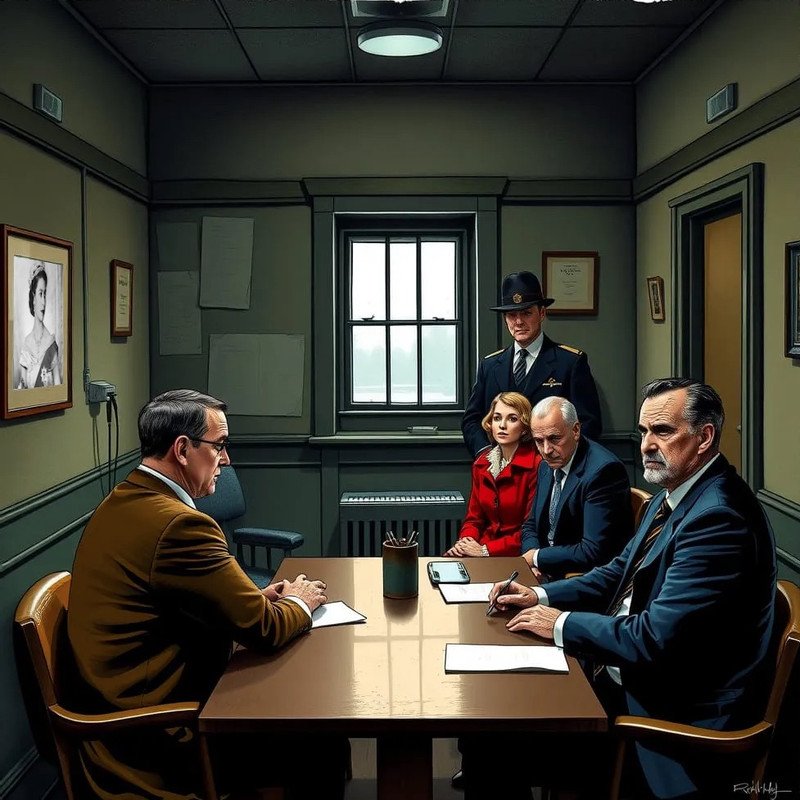 There was a sound of footsteps and chatter on the other side of the door. Constable MacReary came into the room, bringing with him the man whom we had arrested yesterday on the pier. He was wearing a sky blue suit jacket and pants, a pink shirt and a black and white striped club tie. I couldn’t see the socks but I thought they probably glowed in the dark.
I looked at Jane and she looked at the prisoner. ‘How are you? Did you get some sleep?’
‘Thanks for your concern,’ he said, making an effort to sound sarcastic. ‘They found me some clothes from somewhere. I’m still tired.’
‘The clothes came from MacCleod, the tailor,’ MacReary explained. ‘I tried him first. Knocked on his door before the shop opened. He said he had some manufacturer’s samples that Abner could try. No charge, he said, he wouldn’t have been able to sell them if he put them front and centre in the shop window and left them there until Doomsday.’
‘Abner McCall,’ I said, ‘is that your name?’
‘Who wants to know?’
‘Him,’ said Jane, pointing at me. ‘And me as well. It’s easier to do the paperwork if we know what your name is.’
‘His name’s Abner McCall,’ said MacReary. ‘Major Abner McCall. It was on his identity disk. He dropped it while he was drying himself off and I picked it up.’
‘Good work, MacReary,’ I said.
‘Thank you, officer Corsair. I worked the night shift on Thursday, so last night I made sure Abner was as comfortable as possible. That was when I noticed the identity disk. Then I handed over to Anderson. He was on night shift, you see. I was home by seven, in time for the concert on the wireless.’
‘Mr McCall,’ I said, ‘I’d like to—’
‘Major McCall,’ said Major McCall.
‘Sorry. Major McCall, I’d like to ask you about an incident recorded in the harbour-master’s records which occurred aboard the M. V., ahh…’
‘Detective Corsair, P. I.,’ the lawyer interrupted, ‘allow me to introduce myself. I am Camden Harvey, and I am Major McCall’s advocate. I believe that Mr McCall is being held on a charge of resisting arrest. Is that not so, Constable MacReary?’
I looked at Jane and whispered, ‘Where’s he come from?’
Jane looked at me and mouthed, ‘Public school.’ To me it sounded more like an exclusive and expensive academy, complete with a sign on the gate, No workers allowed.
‘Oh, aye,’ said MacReary. ‘He ran away from Detective Corsair and Special Constable Tiptree, who were attempting to stop him committing a suspected offence yet to be investigated.’
Harvey intervened. ‘Alleged offence,’ he said, ‘for which you and these officers have precisely no evidence whatsoever.’
‘No evidence?’ For a moment, I was outraged. ‘I’ve got eighteen crates of moonshine in the evidence room and you won’t allow me to ask him where they came from?’
‘Ten out of ten for observation,’ said Harvey. ‘If your question has nothing to do with the charge on which my client is arraigned, I suggest you refrain from asking it.’
‘Refrain from asking McCall about sixty-five pounds’-worth of bootleg liquor? It takes me a week to earn that much.’
‘Then you have chosen the wrong career,’ said Harvey. ‘It takes me from nine a. m. until mid-day in the High Court. My client has no comment to make on the matter, and secondly, in my experience, juries do not take kindly to Policemen attempting to blacken the character of the accused. “There but for the grace of God go I,” they say to themselves, “suffering all manner of malicious innuendo from a Policeman who has nothing to lose and much to gain by serving us jurors the occasional pork pie.” ’
A moment of silence ensued.
‘Very well,’ I said. ‘I withdraw the question.’
‘Mr McCall might indeed have got away from the officers,’ MacReary continued, ‘had he not lost his footing on a piece of wet sea-weed and fallen into the harbour. From which precarious plight Special Constable Tiptree did a most competent job of rescuing him from the waters and arranging for him to be brought to justice. I do not think I ever saw—’
‘Thank you, Constable,’ said Harvey, as though he did not want MacReary to give his account of the event which had led to McCall being arrested. ‘Now, Detective, in what way is your question about an incident aboard a yacht relevant to the matter of my client’s alleged escape from lawful custody?’
‘I want to know a lot more’ I said, ‘about an incident which seems to be related to a series of break-ins—’
‘I thought as much,’ Harvey interrupted. ‘Doubtless if you went on long enough you would implicate my client in the theft of the
Stone of Scone.
Do you have any further questions regarding my client’s alleged offence?’
The only thing I could think of was, ‘Where is the Major‘s home base? Where is he stationed?’
‘You don’t have to answer that,’ Harvey told McCall. ‘You can decline to answer.’
But it was clear that Harvey had accidentally held a lighted match to the blue touch-paper. ‘God damn it,’ McCall shouted, ‘I’m a U. S. Marine.’
‘Remain seated,’ MacReary told him.
‘I command the élite Tiger Squad in
U. S. S.
Moore.’
‘U. S. S. Moore?’ Jane recognised the name. ‘The American naval base north of Helensburgh?’
‘Do you know the place?’ I asked her.
|
|
Crowds take shelter in a news theatre during a blitz
|
‘Not really,’ said Jane, ‘but I remember seeing pictures of it in a newsreel. Mum and Dad were with me, in the Pathé news theatre, sheltering from a blitz. U. S. S. Moore’s a sort of watering hole, canteen, ammunition dump and dormitory a few miles north of Helensburgh.’
‘Why was it in the news?’
‘I remember it well,’ said Jane. ‘Despite its being a large brick-built barracks half a mile inland, during the War, the Germans announced that they had sunk it. Everyone in the place roared with laughter.’
‘I think we have strayed unnecessarily far from the subject,’ said Harvey.
 ‘Indeed so,’ I said, and I turned to McCall. ‘Major McCall, with your lawyer’s permission, may I ask you, can you buy Chertsey chocolate assortments in U. S. S. Moore?’
McCall looked at Harvey, and Harvey nodded. ‘Stupid and pointless question, but you can answer it.’
‘I can buy them,’ said McCall, ‘but you can’t, because I’m paid in dollars and I’ve got U. S. Marines I. D., and the commissary in U. S. S. Moore has the finest confectionery you’ll find anywhere on the planet, all shipped out in convoys for the American boys beached and miserable and unable to understand a word that anybody says to them in Bagpipe Land. The commissary doesn’t accept Scottish money, and all you’ve got is a lousy warrant card, and that won’t get you nothing.’
As we left the court, Constable MacReary called us over. ‘Now you can see why they call Harvey “The Centurion.” ’
‘Good choice of name. Do you know, a centurion defended Pompei single handed? Hit by three arrows but defeated an army. Just the sort of man you’d name a defender after.’
‘Close, but no cigar,’ said MacReary. ‘He was named after the Centurion tank.’

 ‘The Police left these for you.’
We were still in the Duke’s Hotel. The breakfast waitress handed us two printed sheets of paper, one bearing Jane’s name, the other mine. She made her announcement in a voice that could have been heard on Mars. ‘A policeman came in just after seven this morning and asked Reception to give them to you.’
‘The Police left these for you.’
We were still in the Duke’s Hotel. The breakfast waitress handed us two printed sheets of paper, one bearing Jane’s name, the other mine. She made her announcement in a voice that could have been heard on Mars. ‘A policeman came in just after seven this morning and asked Reception to give them to you.’
‘What?’ I had no idea what the papers could be. ‘Are they arresting us by special messenger?’
‘They’re witness summonses, Sam.’ Jane recognised them. ‘I see them all the time at work.’
‘So what do we need to do?’
‘Just turn up in court where it says.’ She looked at hers. ‘The Sheriff court on Ceàrnag an Fhoghair at ten o’clock.’
The breakfast waitress came back to take our order. ‘They’ve caught up with me,’ I said. ‘After all these years, they’ve found out my grubby secret.’
‘Don’t cry, darling,’ said Jane, clutching my hand. ‘I’ll come and visit you.’
‘I have a stressful day ahead of me,’ I said to the waitress. ‘This is the last you may see of me for several years. Get me bacon and eggs with baked beans and maple syrup.’
‘You have to learn to like porridge, darling.’ said Jane, sympathetically. ‘Why not start now?’
‘Oh, God,’ I cried aloud, ‘I’d forgotten all about porridge. That’s the worst thing they do to you.’
The usher ordered us to sit at the back of the public gallery, beside Constable MacReary. McCall, still in his oddly assorted clothes, sat in the dock. Camden Harvey, the public defence attorney, was already in place at one end of a long table, while the District Attorney arrived and rushed to the other end. The usher called ‘All stand,’ and the Sheriff arrived, took centre stage and laid a dozen sheets of typewritten notes on the bench in front of him.
‘Abner McCall,’ said the Sheriff, looking at the papers in front of him. ‘Where is he?’
‘I represent the accused,’ said Harvey. ‘My client wishes to be tried summarily by this court.’
I asked Jane, ‘What does that mean?’
‘It means it’s a minor case and the Sheriff tries the case by himself, without a jury,’ said Jane. ‘Everything the court needs for the trial is here already, so the whole thing will take an hour or two at most. It means they can get the minor cases out of the way quickly.’
‘McCall is a minor case?’ I asked.
‘Yes, I’m afraid so,’ said Jane. ‘Since Harvey didn’t let anyone say a word about the illicit alcohol or the break-ins yesterday, they aren’t on the charge sheet.’
McCall pleaded guilty, Constable MacReary answered a couple of questions about yesterday’s end of the pier show, and the usher told Jane and me that we were free to leave. ‘Your evidence will not be required.’
MacReary told us that Anderson was on duty. We walked the few yards to the precinct.
‘Case is closed,’ said Anderson, who was manning the front desk of Portree Precinct. He had already heard the result of the trial. ‘Harvey won. That’s that, done and dusted, cut and dried, thanks for trying, that’s all, folks.’
‘That’s all?’
‘Unless you have some new evidence.’ Anderson shook his head. ‘I know that you put in a lot of hard graft, but in the end, resisting arrest was all we could charge him with.’
‘We don’t have new evidence,’ I said, ‘but we’ll be back.’
‘The dinosaurs said that.’ Anderson spoke without looking up from the desk.
‘In the meantime,’ I asked, ‘now that we’ve tried and failed, how can we get back to the big city? ’Cause that’s where our desks are.’
‘Not in a Police car, I’m afraid.’ Anderson looked up from the desk. ‘MacReary the only other man at work today.’
‘He was at McCall’s trial,’ I said.
‘Yes, so I’m on my own here. It’s a thirty-mile drive to the ferry. With or without MacReary, I can’t leave the station for the rest of the day. Try Shaw’s garage, down the road, they’re helpful. They might hire you a car and driver, or they’ll know where you will find one.’
‘Ah, well, thank you for your help and attention. We’ve achieved little, but there’s more to come.’
‘I look forward to it. Really. McCall got off lightly, and he knows it.’
‘Really?’ Jane wondered what exactly that might mean. ‘Was McCall found not guilty?’
‘Might as well have been. Fined two pounds.’
‘Two pounds. What’s that in dollars, Jane?’
Jane did some quick mental arithmetic. ‘Five dollars and eighty cents.’
‘Small change.‘ I said, ’So much for crime doesn’t pay.’
‘See you both later, I hope.’ said Anderson.
Shaw’s hired us a car and driver. I asked whether we might go and see Dunvegan Castle on the way to the ferry, but the driver told us that Dunvegan was twenty miles this way and the ferry to the mainland was thirty-three miles the other way, and there was no way we could go to both. We picked our suitcases up from the Duke’s Hotel, and when we arrived at the ferry, the driver asked for five pounds. We gave him six.
Jane and I reached Kyle of Lochalsh railway station in time to board the last train to Inverness and from there the night train to Edinburgh. Jane and I shared a sleeping compartment. We didn’t get very much sleep.
 Ellis had been to International News and got hold of the Highland Press. He had seen the court report, and he read it to us.
 ‘The court report says the Sheriff accepted that resisting arrest was a minor offence,’ he told us. ‘All McCall had done was run away, he wasn’t charged with anything except resisting arrest, and he’d suffered enough, what with falling in the water and spending a night in the cells, so… Fined two pounds.’
‘Yeah, the court report is right,’ I said, ‘we lost the case, thanks to a public defence attorney called Camden Harvey.’
‘They put you up against Camden Harvey? No wonder the Sheriff never asked you why you wanted to arrest McCall in the first place. Have faith in yourselves. Harvey’s good, but he’s no superman. You lost a battle, but you’ll win the war.’

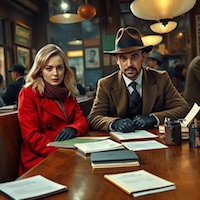 ‘In defeat, defiance, as Franklin D Roosevelt once said.’ I quoted, ‘it’s time to retreat to Operational Headquarters for the inevitable After Action Review.’
Jane said it was Winston Churchill, and I said Winston Churchill was a good man but he wasn’t an American, and Franklin D Roosevelt must’ve said it first.
We were back in Edinburgh. Jane and I took the paperwork across the road from the Police Station to the café, found a table big enough for six, ordered two large Viennese coffees — each — and spread ourselves out across the table-top.
‘As operational headquarters go,’ I said, ‘this place is pretty agreeable.’
‘Two each?’ the barkeep double checked.
‘Yeah,’ I told her, ‘two each.’
‘Five shillings.’
I pulled the change out of my pocket and Jane discreetly pointed out the two identical coins that added up to five shillings. I shall never understand how five divided exactly by two.
‘After that fiasco,’ Jane asked everybody in general, ‘what remains?’
‘Enough to be worth looking over,’ I said.
‘Enough to turn defeat into victory?’
‘Perhaps. Victory sometimes looks like defeat when it’s still in the distance,’ I began. ‘When you get closer to it, you can see what it is.’
‘You’re full of hope,’ Jane smiled, ‘always full of hope.’
‘In my line of work,’ I said, ‘if I don’t crack the case, I don’t get paid.’
‘You’ll get paid whatever happens,’ said Jane. ‘Remember, I sign the cheques. So let’s make a start.’
‘Okay. The Judge’s decision ain’t as final as he thinks it is. There’s a saying in far-off Pennsylvania: despair won’t get you nowhere. We’ve got to start somewhere so let’s start with the victims.’
‘That’s the obvious place.’
‘When in doubt, see a straw, clutch like hell. There are four victims that we know about. Trudy Humphreys, Caitríona Murray, Tiffany Walters and Lauralee Yates. Those are probably stage names. Their real names are in their statements. There are no other known victims. They’re all glamour models, all good at smiling for the camera and looking beautiful, and they all took a short cruise in the M. V. … whatever the Gaelic for Rusty Bathtub may be.’
‘M. V. Cluaran an Luchd-siubhail,’ Jane corrected me.
‘What you said,’ I continued, ‘The skipper on the yacht was Alvin McCall.’
‘A U. S. Marine from M. P. S. 40, wherever that is.’
‘We have incident dates and statements from all the victims.’
‘All the statements are the same. “I came home, someone had broken into the house, or office, or theatre dressing room, and left a box of cheap chocolates and a card with a heart on it.” ’
‘Break-ins,’ I repeated, ‘the perpetrator of which arrived by the most circuitous, strenuous, difficult path possible.’
‘Why?’ Jane asked the obvious question. ‘Why choose to take your chances against an armed detachment guarding a castle when you aren’t trying to conduct any kind of business with anyone who’s living there or working there?’
‘Search me. Facing fire and brimstone, death and destruction, when he could have taken the bus, then when he gets there, taking nothing, not even seeing the woman. So he ain’t a burglar or a mugger.’
‘Just a visitor,’ said Jane.
‘Just a visitor who brings a gift.’
‘If he was a visitor, none of the victims actually saw him.’ Jane put her head in her hands. ‘What on earth is the guy doing it for?’
I thought it over for a few seconds. ‘There was an incident during the cruise, wasn’t there.’
‘Man overboard.’
‘Correct,’ I said, ‘and as a result, they did the cruise again.’
Jane looked up, suddenly standing in front of an oncoming train of thought. ‘Now, here’s a puzzle. If they were shooting glamour for Pure, why couldn’t they just have used the pictures they’d already taken before one of the passengers fell in the drink? Why couldn’t they just check for injury and damage, which would take one hour perhaps, then carry on with the shoot?’
I thought about that. ‘Did the skipper have to get hold of an engineer to check for damage?’
‘No, a man overboard wouldn’t damage the boat. McCall’s a top notch skipper. He would know whether the vessel was seaworthy.… Something happened that meant that they had to abandon the whole shoot and start from the beginning again…’
‘Here’s my guess. The photographer leaned too far over the ship’s rail and fell in the water. Equipment damaged, film ruined. He needed to go back into town and order replacements.’
‘And whoever wanted the pictures would want the whole shoot done again.’
‘Which would mean,’ I thought out loud, ‘the models would need to arrange to stay over and spend time on the repeat cruise. And that would involve them and their agency in a pile of paperwork and expense.’
‘That is one hell of an insurance claim,’ Jane speculated.
I had drunk my first cup of coffee so I swapped the two cups around and began drinking the second one.
The fresh coffee kicked my brain into a spin cycle. ‘Do you think he’d claim for damaged goods on his insurance?’
‘What damaged goods?’
‘You can’t have forgotten all those bottles? We saw McCall unloading them.’
‘Ah, yes! All that liquid gold would be flood damaged stock. Perfectly good whisky but hardly what you’d set in front of a guest in the Michelin starred restaurant in a business class hotel.’
‘Here’s what I think happened,’ I volunteered. ‘McColl has a business giving small group boat tours. Pure magazine chartered his yacht for a photo-shoot. McColl took the models on a tour of the local ports and harbours. The photographer fell overboard and they ran the trip again.’
Jane took over the narrative. ‘Lots of coastal hamlets have small docks, wharves and harbours. And we don’t know that McColl was the photographer. So while A. Man was taking pictures of the women, McColl had moored the boat in harbour somewhere and fetched crates from the local bonded warehouse.’
‘Who’s Eamonn?’
‘First name I thought of.’
‘So by the time the boat completes the tour, it has a pretty valuable cargo.’
‘I believe it, for one. Lots of Highland hamlets revolve around the harbour, the distillery and the Kirk.’
‘We’re probably getting somewhere.’
‘At last, only three days after we lost in court.’
‘The yacht ties up in a new, scenic location some time around mid-day, the photographer spends the daylight hours photographing the models while McColl's accomplice in a nearby distillery mis-appropriates a couple of crates. Then after sundown—’
It was Jane who stated the obvious. ‘It’s a smuggling ring. Under cover of darkness, McColl collects crates of whisky, and stashes them in the hold.’
‘Which explains everything except how McColl sells the crates, who he sells them to, and why someone broke into the houses of the models and left behind a box of cheap chocolates.’
‘Sometimes,’ Jane philosophised, ‘you have to wait a little longer before the clouds part and you can see.’

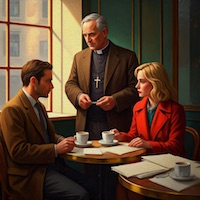 Jane and I had more thinking to do, which meant we needed more coffee. I was on the brink of ordering when we saw a man stand up and walk towards us. Clearly he wanted a word.
‘Hi,’ I greeted him.
‘Good morning,’ he said, in the Scottish accent in which all consonants are whisked together into a well mixed sludge. ‘I’m the Reverend Padraig Beattie— ’
‘Don’t tell me,’ said Jane, ‘Your accent says you’re from the North East.’
‘From Drumgar, actually. How did you know?’
Jane said something in the Gaelic language.
‘Ah,’ said Reverend Beattie, ‘to my great regret, I never had the Gaelic.’
‘Get yourself a coffee and join us,’ I invited.
‘It’s my round,’ Jane hastened to offer. ‘Milk, sugar?’
‘Just milk, thanks.’
As quietly as I could, I asked Jane, ‘Are you going to pay for a complete stranger’s coffee?’
‘Yes,’ said Jane, ‘it’s my round.’
‘What’s a round?’
Jane said, ‘I’ll explain later’ and she went to order the coffees.
I asked Rev. Battie how the Police could help him.
‘Oh, it’s not a Police matter at all. I didn’t realise you were Police officers. I’ll leave you in peace in a moment, but I thought I’d say something because I heard you mention the name of Trudy Humphreys… ’
This could be good news. ‘Do you know Trudy Humphreys?’
Jane returned to the table and the barkeep arrived with three coffees. He asked for, ‘Three and nine.’
Jane took two coins from her bag. He took them, and then he stood in the same place and waited for something.
‘May I trouble you for ninepence, Sam?’ said Jane. ‘Sorry, I don’t have any more coins.’
I found a coin in my pocket and I gave it to the barkeep. He gave me a coin in change. I had still no idea how these coins worked. Nor whether these coins worked, come to think of it. I pulled my coffee towards me.
‘Yes, vicar,’ I said to Mr Beattie, ‘This Trudy Humphreys is an alias, a stage name.’
‘Trudy Humphreys the actress and showgirl?’ he asked. ‘She’s my daughter. Is she in trouble?
‘Not at all.’ I saw him relax. ‘We’re talking about her because she’s a victim of a very odd crime.’
Rev. Beattie took up the theme. ‘She lives two streets away from the manse. She was working away from home when someone got into her house and left— ’
‘A box of cheap chocolates,’ I interrupted, ‘and a card with a heart on it,’ I said.
‘Yes,’ he said, ‘exactly so.’
‘Have you any idea why he did it?’ Jane asked the question before I did. ‘Who he is, what he means by it?’
‘An admirer? A lover?’ I suggested.
‘My guess is, the heart expresses his grateful thanks. Psalm nine, verse one. I will give thanks to the Lord with my whole heart’
‘Thanks for what?’ I asked. ‘I can see that he might be smitten by her…’
‘I won’t know what happened until next time Annabel comes to visit me.’
‘Annabel?’
‘Trudy’s a stage name. She’s my daughter. Annabel Beattie.’
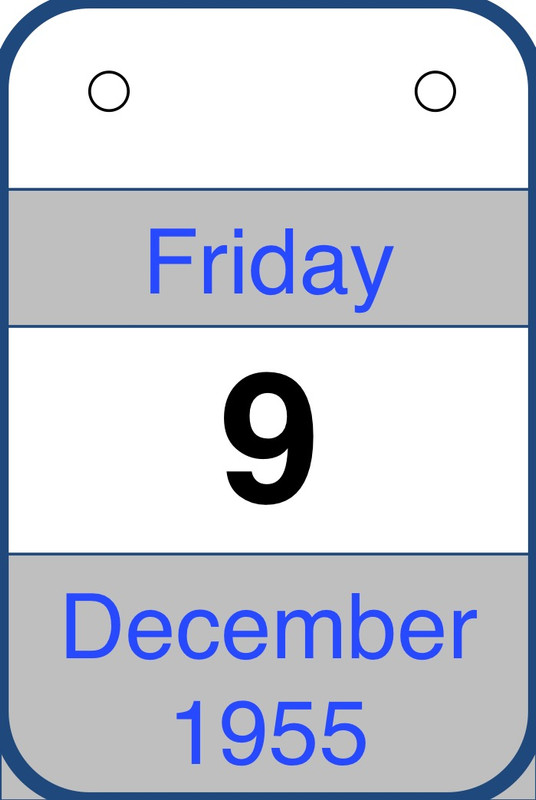 Despite having the name of some sea-going behemoth,
USS
Moore had never been to sea in its life.
It was a sort of ugly, mile square asphalt covered compound, miles from the nearest house and even more miles from the nearest workplace, built beside a natural harbour on the shore of Saint Kentigern’s Loch. Two
Marines with rifles guarded its entrance, and beside them Old Glory flew on a pole. The asphalt was surrounded by chain link fence and topped with barbed wire. It was strewn with grey breeze block buildings and creosoted clapboard huts, jeeps, a couple of helicopters and sailors in fatigues and tin hats. Within minutes, just by using my eyes and ears, I had learned that every man carried a gun, the money was dollars and cents, the food was awful, the drinks were
MGD
and Bud, their sports filled baseball diamonds and basketball hoops, they drove on the right hand side of the road and they called the helicopters choppers.
Despite having the name of some sea-going behemoth,
USS
Moore had never been to sea in its life.
It was a sort of ugly, mile square asphalt covered compound, miles from the nearest house and even more miles from the nearest workplace, built beside a natural harbour on the shore of Saint Kentigern’s Loch. Two
Marines with rifles guarded its entrance, and beside them Old Glory flew on a pole. The asphalt was surrounded by chain link fence and topped with barbed wire. It was strewn with grey breeze block buildings and creosoted clapboard huts, jeeps, a couple of helicopters and sailors in fatigues and tin hats. Within minutes, just by using my eyes and ears, I had learned that every man carried a gun, the money was dollars and cents, the food was awful, the drinks were
MGD
and Bud, their sports filled baseball diamonds and basketball hoops, they drove on the right hand side of the road and they called the helicopters choppers.
I felt at home.
A man stepped away from his basketball game when he noticed that I was driving a Jaguar Mark One. He pointed at it and said, ‘Hey, guys, that must be the Admiral.’
This was my chance. I wound the window down and shouted to him. ‘Hey, sailor, who’s in charge here?’
‘Me,’ he said. ‘Your wish is my command.’
‘You got that wrong, sailor,’ I shouted back. ’How would you like to spend the rest of your Naval career peeling potatoes and chopping onions on night shift?’
‘Rear Admiral Brisling’s office is over there, Admiral, sir. Blue door marked “Knock and Wait,” sir, Admiral, sir.’
‘Good answer, sailor.’
Brisling was younger than Jane and I expected. Mid twenties perhaps, and a high flyer. He wore wire framed spectacles and a lime green ribbed sweater with lime green epaulettes and lime green elbow patches, which gave him the appearance of God Almighty looking out across his desk at a host of angels singing hymns and playing harps.
‘L. B. P. D.,’ I said. ‘I’m Officer Sam Corsair and this is Special Constable Jane Turnbull.’
‘I’m sorry, what’s L. B. P. D. exactly?’
I found my warrant card and held it up so he could see it. ‘Lothian and Borders Police Department.’
‘Ah. Good morning, officers,’ he said. ‘What can I help you with?’
‘Tell me,’ I asked, ‘are there any war photographers stationed here?’
‘Yeah. War photographers. They come here for basic training, boot camp sort of thing, and specialist battlefield experience.’
‘Would you allow us to talk to one or two of them?’
‘Sure thing, Officer Corsair. But don’t arrest any of them, because everyone in the camp has diplomatic immunity.’
Jane suddenly chipped in. ‘No, they don’t.’
I nodded. ‘She’s the lawyer.’
It was as though the host of angels abruptly stopped serenading Brisling. After a short, shocked pause, Brisling smiled.
‘No, they don’t,’ he said, ‘but I had to try. The men expect me to keep them as far out of trouble as possible.’
‘Is there a lot of trouble?’ I asked.
‘Very little.’ Brisling thought for a moment. ‘The occasional drunk and disorderly, shoplifting, dangerous driving. That sort of thing.’
‘We’d like to talk to any photographer who’s been out on exercises with Alvin McColl recently. Past few months.’
Brisling pulled a folder from his desk and leafed through the first few pages. ‘McColl is on shore leave just now but the war photographers are all in a class at the moment. Theory of Optics. Wait here. I’ll be a few minutes.’
Jane asked, ‘How many photographers are there?’
‘Four,’ said Brisling. ‘This is the first year we’ve had so many. We get through quite a few photographers because after they’ve reported on the battlefield for a couple of years, they go for a plum job on the New York Standard or the Texas Comet or USTV. That’s if they survive, of course. No sensible employer would turn away a man who knows how to deal with an enemy invasion.’

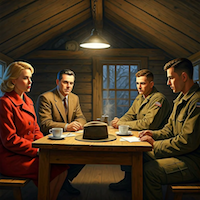 After three minutes or so, Brisling bustled back into the hut, where Jane and I were sitting hoping in vain that an orderly would knock on the door with a tray of coffees.
‘I found him,’ said Brisling. ‘Ensign Kinsley Myers. The class is about important stuff he needs to know, but it finishes in a few minutes and he’ll report here as soon as it’s over.’
‘Thank you very much,’ said Jane. ‘Could I ask you one more thing?’
‘Certainly,’ Brisling smiled at her. ‘Ask away.’
‘Where’s MPO 40? Because some of the evidence we have— ’
Brisling’s face changed. ‘That’s a secret, ma’am. If I told you that, I’d have to kill you.’ Pause, then he lightened up. ‘And please don’t look at my in-tray because the mail on the top of the heap would give the game away.’
‘I get it,’ Jane said without looking at it. ‘I am discretion incarnate. ’
‘So was Ethel Rosenberg,’ said Brisling.
Jane said, ‘You can rely on me, sir,’ which Brisling must have found reassuring.
Just in time to stop the atmosphere going as sour as a pickled lemon, a knock came at the door, and a shout of ‘Ensign Myers, sir.’
‘Come in, come in.’ Brisling took a welcoming tone, and he looked at me and said, ‘I’d prefer to sit in on this interview, Officers, if that’s okay.’
Jane and I looked at each other and I said, ‘Okay.’ It wasn’t really okay, but we were there on sufferance. We were lucky not to have to fill in a pile of forms and then be frog-marched ignominiously to the gates by those two Marines with rifles.
Myers’s appearance came as a shock. Jane’s jaw dropped. Myers looked a short but tough guy. Five foot eight tall and five foot eight wide as well, he looked as though he could lift up tall buildings and walk under them. The sort of sailor that you want on your side in a war. He carried a massive black and silver Tolliegraph plate camera, unusable in battle but perfect for portraying a victory: flags being hoisted, despots standing handcuffed in court-houses, medals being pinned on chests and the eternal sail-pasts with palm trees in the foreground while the sun set in the background. Myers wore his physical power lightly, looking around the room and smiling at us with a cheerful ‘Hi, y’all!’
‘North Carolina,’ Jane guessed brightly.
‘Bluesboro, ma’am,’ Myers chirruped. ‘How did y’all know?’
‘Accent,’ said Jane.
Myers shook his head and pulled a face which meant, ‘I don’t believe y’all.’
‘I didn’t tell them,’ said Brisling, and he went on, ‘These officers are from the Scottish Police.’
‘LBPD,’ I said.
Jane held up her ID. I’d forgotten which pocket I put mine in, but I was lucky. Myers didn’t ask to see it.
Jane was giving me my cue. I began my script. ‘Mr Myers, have you ever sailed on the MV…, ah, the MV…’
Myers kind of sat to attention as Jane filled in for me with practised ease, ‘Cluaran an Luchd-siubhail.’
‘Sure have, Officer. Twice over. I had a lot of fun. Am I in trouble?’
‘I don’t think so,‘ I said as gently as I could, ’and in any case, as long as you’re a recognised resident on board USS Moore, you have diplomatic immunity.’
Jane, knowing that to be an expedient untruth, stayed quiet. Brisling, on the other hand, told Myers, ‘Y’ain’t got nothing to worry about, sailor. These guys can’t throw you in jail even if they wanted to.’
‘Jail’s right across town and I ain’t got a nickel for the street-car,’ I said.
‘Two nickels,’ Myers corrected me, ‘ ’cause I’d need one.’
‘You run behind it,’ Jane laughed.
I started on the important question. ‘We’re here because I believe there was an incident on the trip. We’d like to know what happened. Go slow, take your time, try to recall everything.’
Myers thought for a moment and began, ‘A friend of mine who does portraiture got a phone call from a picture agency asking him to photograph some models for the glamour market. Four belle of the ball types who happened to be working around these parts. My friend was booked solid and he passed the invitation to me. Of course, I’d joined the Navy by then, but it sounded like an offer I couldn’t refuse. I asked Alvin if he could let me go on leave for those dates.’
Brisling interrupted. ‘That’s Alvin McCall.’
Jane looked at me in a way that meant I thought it might be.
‘He’s running Myers’s basic training. How to polish your boots and what to do if you’re ambushed by a heavily armed enemy platoon when the only things you’ve got to fight them off with are a camera and a Press pass.’
‘Is that really possible?’ I asked.
‘Yes, but you’d probably break the camera.’
 ‘Better to hide up a tree,’ said Jane. ‘Once their faces appear on Wanted posters, you’ll be safe as houses. ’
‘Yeah, thanks.’ Myers went on. ‘It’s really useful stuff. So Alvin said he could book a yacht for those dates and he would take me sailing. He said, if the women agreed… ’
Brisling intervened again. ‘Sailors like Myers here sometimes need to helm a small wind-powered craft. Quiet landings out of sight, behind the lines, under the radar … sure freaks the enemy right out.’
‘So I asked the picture agency,’ Myers went on, ‘and they got back to me the same day. Glamorous ladies relaxing in the sunshine on a yacht. They loved the idea.’
‘Are we getting closer to describing this incident you’re telling us about?’
‘Not long now,’ said Myers. ‘We were a mile or so offshore. I was leaning against the rail, photographing Trudy, when the yacht lurched and I fell in the sea. The heavy camera was round my neck dragging me down, and the ladies threw me a lifebelt and jumped in to try and help.’
‘And you had to abandon the whole tour?’ I asked him.
‘Plates and camera all ruined,’ Myers agreed. ‘We had to turn back and plan a re-run.’
Jane was struck by a thought. ‘Where was McCall during all this?’
‘Alvin and I picked the boat up in Ullapool and the models were waiting for us there. After that we sailed around the Inner Sound. We spent nights in small harbours along the coast. ’
‘What do you mean by “small harbours?” ’ I asked.
‘There are lots of them. Used by the fishermen years ago. Disused now, but safe and useful. Alvin seemed to know them by instinct, where they were, where it was safe to moor. He would leave the yacht after breakfast and wave us off, we’d spend the morning in harbour shooting pictures, and by lunch time he would be back. Once Alvin was back on board, he’d sail us to the next small harbour while we carried on shooting.’
‘What was Alvin doing in the mornings,’ I asked, ‘while you were at sea?’
‘I don’t know, sir— ’
 We were interrupted by a knock on the door and a shout. ‘Duty orderly, sir. Coffee?’ Brisling opened the door. The orderly had a trolley with cups, a coffee urn and everything else a demanding and thirsty officer might want.
‘Cliff, hi. We’d like four coffees and some of that shortbread,’ said Brisling.
‘Do you have Viennese coffee?’ I asked him.
‘Ah.’ Cliff looked pale, fresh out of school, yet to be turned into a warrior. ‘No, I ain’t, sir. I have Robusta, sir. Finest coffee in the world. The consignment arrived on the supply ship at six this morning direct from Hawaiï. Roast and ground fresh this morning in the mess kitchen, sir.’ He shook his head as he arranged four china cups on a tray, poured the coffee and put the tray on the table.
‘Well,’ I said, ‘that does smell special. How much does the Police Department owe you for this?’ I asked.
‘Free of charge, sir, courtesy of the American taxpayer. But you could give me something to show your appreciation because I ground it all and boiled the water myself.’
‘I bet you milked the cow, too. Here.’ Jane felt in her purse. ‘Half a crown.’
‘Thanks, ma’am.’
‘Thank you, Cliff,’ said Brisling.
Cliff left us. His trolley was heavy laden, which meant he had other doors to knock on. Quite a few by the look of it. He pocketed the coin and pushed his trolley off to the next clapboard hut, leaving our door open.
‘Not only can he not work a door,’ said Brisling, ‘but just between ourselves, he has no idea what half a crown is.’
We truly appreciated the coffee.

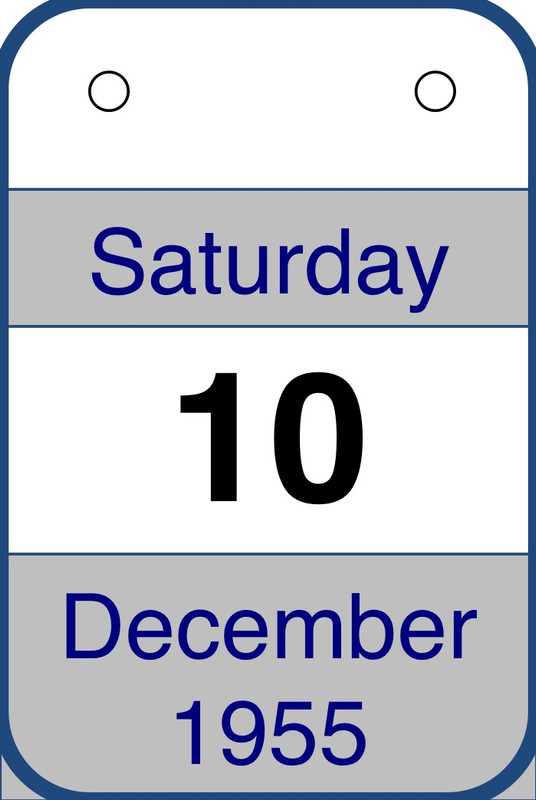
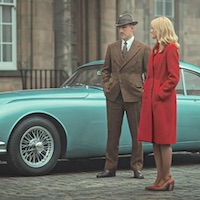 Jane and I awoke together in the hotel. Breakfast was the usual luxurious affair, large portions of anything we wanted, then I suggested to Jane that today might be a good day to go looking for Alvin McCall.
‘Will I be paid for it?’ Jane asked. ‘I was planning to go to the zoo or look around the palace.’
Some instinct told me that Jane had no interest in zoos or palaces. ‘Her Majesty’s spending the day walking the corgis round the zoo.’ I said, ‘It’s their favourite place, so, you’ll have to put all that off for a week or so.’
‘How do you know that?’
 ‘She called me up and told me. Come with me, yeah? You’ll get paid provided I can put your overtime on expenses. What’s your fee for a week-end day?’
‘Saturday is three guineas,’ said Jane, ‘Sunday is four.’ She had the answer ready. She obviously had the gift of question-guessing.
‘What’s a guinea? I was confused before, but now… Is it anything like a half crown?’
‘It’s posh money. Prizes, record players, antique furniture, and my wages, of course. It’s a bit more than a pound.’
‘Seems a bit on the low side. Can’t you ask for more? You look like you don’t eat enough.’
‘In that case,’ said Jane, whose duties as administrator included authorising the expense and expenditure claims, ‘I’ll ask the admin wallah how much you can put on your bill for services.’
‘Wallah,’ I repeated, ‘as in, Wallah do while you are far away?’
Jane shook her head. ‘That was Frank Sinatra, Sam. I meant the clerk who checks the expense claims.’
‘I know the lady,’ I said, ‘and she sure is the generous type.’
We put our coats on, found the Jaguar in the car park where we’d left it, and we climbed inside.
‘My thinking cap’s in the glove compartment,’ I said. ‘It’s a good one. I got it at Janner’s.’
‘No,’ said Jane, looking in the glove compartment as though she expected to find it, ‘this one’s pink. Yours is blue. You must’ve left it in the room.’
‘I can’t be bothered going back for it. I’ll think when we get back. Until then I’ll do some guesswork.’
I knew that McCall was on leave. My guess was that he had spent Monday to Friday sailing around the sea-side fishing villages where his accomplices sold him the bottles of liquor that they had stolen from the village distillery or the village warehouse, and he would spend the week-end — today and tomorrow — filling orders from some of his customers, and storing the rest of the bottles in the shops that he controlled, until the barkeeps and the maîtres d’hotel and the late night drinking dens came and bought them. Then come Sunday evening the yacht would be moored in a harbour somewhere and on Monday he’d be back at the day job aboard USS Moore.
‘Of course,’ I told Jane, ‘I’m only playing my hunch. This could be a dud. McCall could be helping the Queen walk the corgis for all I know. And in any case, I don’t know who his customers are. Any ideas?’
Jane thought for a moment. ‘The biggest hotel in town is the Grand Azure, so if it’s a customer of McCall’s syndicate, then it’s probably the biggest customer. So he’d go there first.
‘Yeah. Harvard School of Business, he say, get the big money in early.’
‘And the Grand Azure is just half a mile away from Moray Circus and the office of Spring Cleaning.’
‘Unless it’s Happy Land this week,’ I said. ‘And by fortunate co-incidence, the Grand Azure is where the nearest we’ve got to an eyewitness works.’
‘So my best guess is, McCall has a load of Scotch stashed away somewhere, and he intends either to store it at Moray Circus or to sell it door to door to the hotels he knows will buy it.’
‘Let’s play your hunch, then,’ I said. ‘Where’s McCall going to tie the yacht up?’
‘Oh, I don’t think he’ll bring it by sea. From USS Moore to Edinburgh is four hundred and fifty sea miles.’ Again, I sensed that Jane had been question-guessing, and she was pretty good at it. ‘The yacht won’t fit in the Union Canal. It could probably go through the Caledonian Canal, but that’s four hundred and fifty sea miles, which takes twenty-four hours of sailing, and you have to get past the Loch Ness Monster on the way.’
‘What will she have to say about it?’
‘ “We can’t go on meeting like this,” probably. No, I say he’ll land the contraband at the Navy base, put it into the back of a Jeep and drive it along the A8. Sixty-five miles.’
‘Land miles this time?’
‘Land miles, because Jeeps don’t float.’
‘And the A8 is like the Interstate, yes?’
‘Not much, Sam. It takes a two and a half hours to go sixty-five miles on the A8.’
‘You knew I was going to ask about him sailing from USS Moore to Edinburgh, didn’t you,’ I reflected.
Jane nodded and smiled. ‘I did think that you might. Yes.’
‘You had the answers ready. You should join the Police Force. They need brains like yours.’
‘I’ll think about it. I’ve got my pink thinking cap somewhere.’
‘It’s in the glove compartment.’
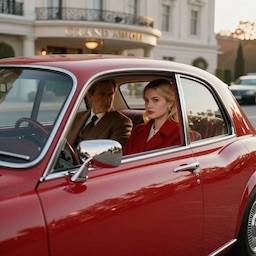 We drove across town to the Grand Azure. We found a spot in the car park where, with luck and a following wind, we could observe who came and who went, while attracting little attention. The vigil began.
After five minutes, Jane asked, ‘Do you think the restaurant will be open enough to sell two Viennese coffees in paper cups?’
‘I don’t know,’ I said, ‘but it’s worth a shot.’
Jane went into the hotel and came back with two paper cups of hot coffee. ‘Guess what?’ she asked.
‘I can’t,’ I said.
‘Policewoman’s instinct. I looked in the dustbin. There were a couple of empty bottles, one labelled Inchleck, the other Drumgar. Which means the Grand Azure buys smuggled whisky from McCall and Company, Duty Free Off Licence to the Gentry.’
‘How do you work that out?’
‘They’re single malts, named for the towns in which they were distilled. Drumgar and Inchleck are small towns on Caraid Loch near USS Moore. So, if you worked on USS Moore and you were picking up stolen whisky… ’
‘Are they good Scotch?’
‘The finest. Rare and fabulously expensive.’
‘We really have to catch this guy. And Jane… Mind if I put my arms around you?’
‘I hoped you might ask.’

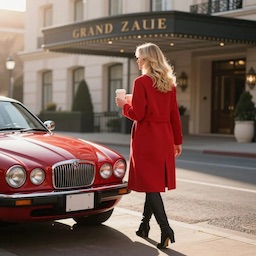 I know everything there is to be known about surveillance. Wearing the hat of a private eye has given me long experience skulking in the shadows on the mean streets. Here I was doing the same job in Scotland, parked in a borrowed Jaguar Mark One with my beautiful assistant half my age, Special Constable Jane Tiptree, watching and waiting outside the Grand Azure Hotel for we knew not what.
The hotel makes Viennese coffee as good as any this side of Pennsylvania and better than most, and you can’t do surveillance without a nearby source of good coffee. Hamburgers would’ve been nice too. At a pinch I’ve even been known to snack on a hot dog, but Jane told me the nearest fast food joint was a couple of miles away. Jane had brought two large paper cups brim-full of the coffee.
‘This hotel doesn’t sell hamburgers,’ she said, apologetically.
‘How about fish and chips?’
Jane shook her head. ‘They ran out of newspapers to wrap it up in. And watch your language. In Edinburgh, we call it a fish supper.’
‘Even at breakfast time>’
‘It’s elevenses time. Now, we’ll probably be sitting together for hours, so where do you want me?’
We balanced the cups awkwardly on the dash while we arranged ourselves so that I had my arms wrapped around Jane and with an effort we could look into each other’s eyes and kiss from time to time. This was a big improvement on the usual stake-out, sitting for hours with only a day old New York Standard for company, reading about a St Bernard dog walking all the way from Chicago back to his old home in Queens while waiting to see who the accused wife walked into the apartment with and how long he stayed there. I’d recognised the dog. Its name was Roosevelt and I’d spent two days looking for it.
With sadness, we had also learned that this hotel also procured and poured contraband whisky. Optimistically trusting each other’s guesswork, Jane and I thought it possible that a load of bootleg liquor would arrive here, if not today then tomorrow, and if not tomorrow then the day after, or the day after that. I clutched Jane closer. She didn’t mind too much.
We waited almost silently and almost motionless for something to happen, which is what always happens on stake-outs, but then it happened.
Jane saw the flames first. She yelled and pointed.
‘Where?’ I yelled back.
‘There. In the downstairs bar. Where I’m pointing to.’
Bells began ringing. Someone had had enough sense to hit the fire alarm. At least the staff knew what to do. Customers began piling out of the doors and into the car park. We ran over to them.
‘LBPD!’ I called out. ‘Anybody hurt?’
‘Who?’ A woman in a bathrobe and slippers, obviously just evacuated from the hotel in a hurry, hadn’t understood.
‘Police.’
‘Why didn’t you say so?’
Jane and I pushed past her, through the grand entrance and into the lobby. The fire in the bar had already spread across half the room. The door to the bar was wedged open, and already there was dense black smoke pouring into the lobby. I put my handkerchief over my mouth and looked at the fire. I didn’t see anyone, no calls for help, everyone had left, no-one trapped. I pulled the wedge from under the bar-room door, letting it swing shut. We had a few seconds to look for anyone left behind.
Jane was already coughing and striving for breath. I told her not to be a hero. ‘Get out, or get down on the floor. Smoke rises.’ I knew what was burning, and it was beyond anything you could put out with a fire extinguisher. This was Flareol, nasty, sticky fuel that operatives sometimes took with them on deniables and when they came back, they never told anybody what — or who — they’d used it on. Nothing else made smoke with that colour and with that smell, and if you searched a hundred miles in every direction, you’d find only one place it could have come from.
My eyes were stinging. I couldn’t see Jane.
‘Jane!’ I shouted, looking around, listening for an answer above the ringing of the fire alarms. I didn’t hear her reply. I couldn’t see her, and I couldn’t stay and look around. Without breathable air, now, I would choke. I turned back towards the grand entrance, and I saw Jane lying on the floor, unconscious, face down, a few feet ahead of me and a few feet from the entrance doors, the car park and the fresh air outside. I grabbed her arms and tried to pull her out behind me, but I could only move her a few inches and my chest was bursting. I felt ashamed to do it, but I left her there, hoping that there would be an air current under the smoke and she would be breathing that. I fell against the main entrance door, gasped for breath and yelled to the line of guests and staff, ‘Does anybody want to help me?’ Nobody volunteered, so I pointed to a fit-looking man at random and called, ‘You! Come over here.’
The man came towards me and told me his name was Arthur
 |
| Arthur receiving the Police Bravery Medal |
and he didn't think he could help. I said, ‘There’s a woman passed out. Take a deep breath, come with me, grab one leg, I’ll take the other, and we’ll pull her out here.’ We heaved her onto the asphalt, I knelt beside her and Arthur melted back into the line. I made a mental note to nominate Arthur for a Police Bravery Medal. Jane was breathing. Her eyes opened. I heard the bells of a fire engine. I said ‘You’re alive. Thank you, God,’ to myself, but Jane heard me. And God, too, of course.

 The hotel was well alight, with flames at all the windows. People were milling around in the car park, some in day clothes and a handful in hotel uniform, most of them probably wishing that they had grabbed a warm coat when the fire alarm rang. The bell of the fire engine sounded close and it was getting closer. Hank and I had pulled my assistant, and girlfriend, Jane Tiptree out of the burning hotel and left her on the tarmac to recover. She had been overcome by smoke, and now she was lying face down in the recovery position. I sat beside her.
The fire engine arrived and six men in their flame-proof clothes leaped out of it. I heard a shout, ‘Leading Fireman Hawkins. Is everyone in the building accounted for?’ Hawkins was seven feet tall and built like an ox. The rest of the crew unravelled the hoses and pointed them at the building.
A man in a suit, who had in his hands the guest register and a typewritten sheet of paper, called back, ‘Yes. There’s nobody inside.’
‘Thank God for that, Give me the lists.’ The suit gave the papers to Hawkins, who pointed to Jane and said, ‘Who’s that?’
The ringing of the alarm stopped as water landed on the flames. The building was drenched in seconds, but the flames did not seem to be dying down.
‘She’s a Police officer.’ said the suit, pointing at me, ‘And so is he.’
Hawkins walked over to us. ‘She needs an ambulance.’ he observed. ‘There’s one coming. We called it ’cause we knew there’d be casualties.’
‘You did right. Thank you. If it’s of any use to you, I can tell you that the fire was started on purpose by someone who could get hold of Flareol.’
‘I’ve heard of it.’ Hawkins nodded. ‘Nasty stuff.’
‘Meant for burning down buildings on covert ops. Hard to extinguish.’ Hawkins would have known that anyway. ‘These people,’ I waved my arm at the customers and staff standing around, ‘are lucky the hotel took emergency exits seriously.’ Hawkins must have realised that, too. ’Okay if I ride along in the ambulance?’
Jane stirred. ‘Stay here. Arsonists come back and look.’
‘Hold on tight, Jane. OK, I’ll stay here but don’t worry, I know what ambulances cost, and I’ll pay the bill.’
Jane did not move. ‘If I were you,’ she coughed, ‘I’d stay here and call for armed back-up.’
Golly! That meant, Jane thought it possible that I’d make an arrest today.
‘Jane,’ I said to her, ‘I’ll visit you when things have quietened down.’
Jane spluttered. ‘No, Sam, you stay here. It’s when things quieten down that the arsonists will come.’
‘In that case, stay alive until I get there.’
The ambulance came to a stop in the car park. The paramedics exchanged brief words with Hawkins, scooped Jane up in a stretcher and with silent efficiency bore her away. Which is how I began my vigil, with no idea how long I would be sitting in the car watching the smouldering debris of the Grand Azure hotel without even the New York Standard for company.
 ‘Wake up, ’tec! It’s the cavalry.’
He rapped on the window of the Jag and woke me up. I yawned and wound the window down. ‘Do the dentists here make house calls?’
‘Not cavity, sir. Cavalry. Reinforcements.’ He was mid-twenties, he wore Police uniform and he was carrying a rifle. ‘Firearms officer Rae Hardy, sir.’
I must have been asleep for an hour or so. The sun was lower in the sky, the crowd had gone. They were probably sitting comfortably in the bar of another hotel laughing, drinking and exchanging tales of their exciting adventures. There was still one fireman in full fireproof garb watching the occasional flickers and the dying embers, just in case something in the detritus suddenly went off bang. I asked Officer Hardy the obvious question, ‘What’s going on?’
Rae smiled broadly. ‘Now you say, “For this relief much thanks.” ’ For one whose day in, day out job was to shoot people, Officer Hardy was astonishingly cheerful.
He had chosen one of the few quotations that anybody on the planet would have known. ‘That’s Hamlet, isn’t it.’
‘No,’ said Officer Hardy, ‘that’s Francisco. Hamlet doesn’t come in until Scene Two.’
‘You obviously went to grammar school,’ I said, and I suppressed another yawn. ‘Tell me, what’s going on?’
‘Jane Tiptree sent a message to Greyfield Square saying you needed armed back-up.’
‘Yeah. She told me that, too, but I don’t. All is quiet on the western front, as Paul Bäumer would have put it. We’ll be sitting watching the fire die down.’
‘Not a mouse stirring.’
‘Polonius, isn’t that?’
Rae shook his head. ‘Close but no cigar. Do you mind if I get into the car?’
‘Make yourself at home. So who said the mouse… thing?’
‘Francesco.’
‘Was his first name Sam?’
‘Sadly, no. Now, do you want to know why I’m here?’
‘I thought you’d never ask.’
‘Ellis briefed me that you were lying in wait for case-hardened whisky smuggler, purveyor of cheap chocolates to the most beautiful women in Tinsel Town, virtuoso of the inland waterways and all-round bad guy, Alvin McCall, and in case he’s brought a gun to a bonfire, I am here to shoot him and any accomplices he may have with him before they shoot you.’
‘That’s quite a big brief.’
‘Only we call it ‘back-up.’ ’
I was beginning to understand, but only beginning. Clouds were obscuring my brain. I had a long way still to go. ‘So how are you planning to spend the next couple of days?’ I asked him.
‘Well, for one thing, I can keep you awake. And if McCall shows up, and if he’s as prickly as Jane Tiptree said he is, I can shoot him.’
I said, ‘That makes me feel a great deal safer.’
‘Really?’ There was that mile wide smile again. ‘Then it’s working already.’ I don’t think Rae grasped the intended irony.
He settled jauntily in the passenger seat, and we began the long watch.
When we awoke, it was dark. The flames had died away, the watching fireman gone home to bed and in his place there stood a sign, ‘Danger, Keep out.’
 A woman, in her fifties I guessed, came over to us and asked whether we were all right — we were — and she asked whether she could do anything to help us. She’d seen the Policeman in the passenger seat and suddenly felt overwhelmed by sudden bursts of compassion and curiosity. I said yeah, you could fetch us two hamburgers with cheese and extra onions and two cups of coffee from the nearest McDonald’s and don’t tell anyone that we’re here.
Rae asked, ‘What’s McDonald’s?’
‘Cross between a Lyons Corner House and a Wimpy.’
‘What’s the food like?’
‘Hamburgers. Coffee. Staff of life, if you’re a Policeman on stake-outs. Not much else.’
The lady came back ten minutes later bringing our evening meal, ‘I don’t know anyone called McDonald but the café on Bale Street made all this specially,’ and we were as grateful for our dinner as we were astounded when she refused our offer to pay for it. When she asked what we would like for breakfast, Rae said, immediately, I kid you not, ‘Hamburgers just like these. Cheese, extra onions, one tea, one coffee,’ and I added, ‘Hold the cornflakes.’

 Darkness fell. When you’re on a stake-out, you notice things like that. This was December in Scotland, and darkness fell early. I was still sitting in the Jaguar, parked at the back of the Grand Azure Hotel, watching what was left standing after the fire. Obviously nervous about leaving me on my own in a car park, Jane had arranged for firearms officer Rae Hardy to drive across from Greyfield Square precinct and sit in the passenger seat, as she had a hunch that our suspects would come by to look at the burned-out shell.
A kind lady had gone to a café somewhere nearby and brought us hamburgers and coffee. As she held the meals out to us, Rae recognised her.
‘Hey, Soraya, is that you?’
‘Yes, it’s me. How are you?’
‘I’m well. Saving up for a return visit.’
‘What’re you doing here?’ Soraya looked around at the desolate scene. ‘There’s not a lot to see.’
‘Police work,’ I said. ‘Rae’s not allowed to talk about it.’
‘You look as if you’re on the look-out for bad guys.’
‘Yes.’ Rae took up the chatter. ‘We’ve got an especially heavy book to throw at any bad guys we notice.’
‘Lady,’ I said, ‘I hate to break it to you, but standing there, you’re going to draw attention to him and me, and if there are any bad guys around, they’ll get scared and flee the scene, and then we’ll have to get out of the car and run after them, and our hamburgers will go cold. So, look, if we’re still here, we’ll see you over breakfast. And by the way, thanks for your help.’
Soraya stood up and walked away.
‘She nearly blew our cover,’ I said. ‘Now, duty is still calling. Keep a look-out for McCall and anyone he might have with him. How do you know her?’
‘I brought my girlfriend here. Soraya was our waitress.’
‘I know where I’ve seen her before. I got a statement from her early on, when we got the first reports of break-ins.’
Darkness was falling. We were wolfing the hamburgers.
Rae noticed the two men first. They stood with their backs to us, staring at the burned-out Grand Azure. One looked about forty, the other perhaps twenty-five. Raincoats and scarves and hats, like you’d need in Scotland in December.
I turned to Ray and pointed at them. Quietly I asked him, ‘Are you thinking what I’m thinking?’
‘Yes.’
‘Well, you just finished eating your hamburger and I’ve got a couple of bites left. Go and ask who they are.’
Rae opened the door of the car quietly enough. They didn’t seem to notice it.
‘I think you can give me the rifle,’ I said. ‘You don’t want them soiling themselves, and I know how it works.’
‘Sure.’ Rae put the rifle down on the passenger seat. ‘Watch my back.’
‘On the firing range I’m an eight out of ten with one of these.’
‘Let’s hope you don’t try firing it, then.’
They might see Rae and make a run for it, I thought. I opened the door on my side and made myself ready to chase them. Or if the unthinkable played out, ready to fire. Rae walked over to the two men, talked to them for a moment and came back to the car. He made a sign as though using one hand to shelter a small animal who sat in the palm of the other hand. I recognised it. The deaf sign for
Safe.
When he was close enough, he said, ‘Sightseërs waiting for their bus home.’
‘Did you see any ID?’
‘No, I believed them. Told them the building might fall down and they shouldn’t try to get inside.’
‘I’m not sure. Let me go and speak to them.’
‘You think I just let a crook go free?’
‘I just have this instinct that Jane’s right about the arsonists returning to their fire. And they’re still standing, looking at something, looking for something.’
The men — I was already thinking of them as suspects — didn’t seem to take fright when I went over to them and flashed my warrant card.
‘I’m Sam Corsair, LBPD. Officer Hardy just spoke to you— ’
‘Yes, I noticed that too,’ said the older of the two. American accent.
Now I was damned sure I recognised him. ‘What part of the States are you two from?’
‘Kentucky. Now, Officer, our bus is due to leave in a couple of minutes.’
‘Oh, I won’t keep you. Just… do you have any ID that you can show me?’
‘No. I told your collague— ’
‘You sure? ’Cause we have to do so much paperwork. Just a business card, or an envelope addressed to you?’
‘No.’ This time, the younger man answered for him. ‘Sorry.’
‘Maybe a master mariner’s ticket?’
‘No! It’s in my quarters back at the base.’
I hadn’t noticed Rae quietly sauntering up behind me. When he spoke, I looked around and I was pleased to notice that he’d left the rifle in the car.
‘Alvin McCall,’ he began, ‘you’re wanted for evasion of customs duty and arson. Kinsley Myers, you’re wanted for arson and housebreaking. Sorry to spoil your evening, but you need to come to the Police station. I’ve got a Police car parked around the corner. I’ll give you a ride.’
‘How did you know their names?’ I asked.
‘From your notebook. You dropped it in the footwell.’
‘See you back at the precinct,’ I said.

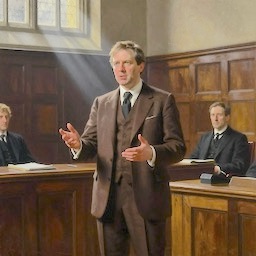 Sheriff MacDougall picked up the sheets of paper in front of him and looked straight at Rae and me.
‘Who are you?’
‘Firearms officer Rae Hardy, sir— ’
‘Not you. The other one.’
‘Private investigator Samuel Corsair, sir. For the time being employed to investigate this case, sir.’
‘I hope you enjoyed it. Now, Regina and… I’ve left my reading glasses at home today. I can’t make head nor tail of this charge sheet. You might have used a bigger typewriter. Who are these defendants and why are they in the dock before me?’
The Court was a small room, built to seat perhaps six people in comfort provided none of them smoked or had recently been exercising. I recognised the traditional lion and unicorn on the wall behind Sheriff MacDougall’s seat. His seat stood on a podium about a foot above the floor. Decked in his traditional fluffy wig, Sheriff MacDougall brought to mind the judge of many a newspaper cartoon. He looked down at us as we tried to share everything we had learned about the defendants in the past three weeks. Rae, the Judge, McCall, Myers and I were within ten feet of each other, and there were lawyers and officials and a clerk besides, so the place was on the crowded side.
‘The defendants are Alvin McCall and Kinsley Myers, sir,’ Rae replied, lucky to get the easy question. ‘McCall is charged with evading lawful duty on alcohol and Myers with house-br— ’
‘Evading lawful duty? Does that mean smuggling whisky?’
‘Yes, sir.’
‘If you mean smuggling, then say it. All this goddamned sesquipedality doesn’t impress me, you know. And this,’ he squinted, ‘arsenal? Football hooligans, are they? Bringing flasks full of hooch into football matches and sharing them with friends?’
‘No, sir.’ I thought it was time I let Rae know that I had his back. ‘Not Arsenal, sir. Arson. McCall—’
‘Which one’s he?’
‘He’s the older one, the one on the left, sir. He’s charged with evading lawful, I mean, smuggling. Myers is charged with house-breaking. The arson… we believe they were responsible for the fire at the Grand Azure Hotel, sir, there was a turf war between McCall and some other boot-leggers— ’
Rae muttered, ‘Do we?’
I muttered back, ‘Yes, we do. What else could it be? Am I right or am I right?’
‘Fire at the Grand Azure?’ The Sheriff had obviously not yet read about it. He must have lost those eye-glasses a few days ago. ‘Good Lord. This is catastrophic! Where are the Stonecutters going to meet?’
Rae supplied the answer. ‘People will fall over each other to offer you a meeting room, sir, I’m sure you’ve nothing to worry about. At the moment, though, we don’t have enough evidence to charge either of the defendants with arson, even though they did it, so further charges are pending, but none of them is anything at all to do with football matches.’
‘Just safety matches, I suppose.’
‘Matches and a canister of Flameol, sir,’ I said, looking at the evidence bags for long enough for the Judge to notice that I was looking at the evidence bags.
‘Further charges are pending.’ the Sheriff repeated. ‘That means you aren’t sure what they were up to.’
‘Yes, sir, but if they’re not sent to the Big House,’ I thought I ought to point out, ‘they’ll leg it to the naval base at USS Moore and we’ll not see them again.’
‘Whyever not? They can’t just vanish like mist in the breeze, can they?’
‘That’s a very good way of putting it, sir. They’ll claim diplomatic immunity and disappear on the first supply ship.’
‘Diplomatic immunity? Never heard such rubbish. Look at them. They couldn’t tell a diplomatic passport from an ice lolly wrapper.’
Without thinking, I asked, ‘What’s an ice lolly?’
‘How I wish the Colonies could speak English.’ the Sheriff opined. ‘That’s a popsicle to you.’
‘Sir,’ Rae’s knees were trembling. Were we about to lose the case again? This War of Independence denier could get us both fired. ‘If we go to USS Moore with an arrest warrant, and McCall and Myers say they have diplomatic immunity, the Marines will march us to the gate, close it behind us and have a good laugh about us. These men have scared four women witless with their antics— ’
‘You turn up at the gates, hold up your warrant cards in one hand and your arrest warrant in the other, and the guards should forthwith pick up McCall and Myers, carry them to the gate and throw them bodily into the back of your, ah, Paddy wagon.’
‘That’s fairly unlikely, sir,’ I said, shaking my head. ‘Not only have they got diplomatic privilege, like they were standing on the soil of the USA, but the guards’ve got rifles the size of telegraph poles. We can’t do anything without their co-operation, and we won’t get it.’
The Sheriff stared out of the window for a moment of reflection.
‘They scared some women stiff, you say,’ he said, slowly, quietly and thoughtfully. ‘This is serious.’
‘Yes, sir. Glamour models from Pure magazine. You see, on the— ’
‘That’s even worse. Tell me, in the fewest and shortest words you can think of, what they were doing, and whatever it was, I’ll put them behind bars pending a full trial. The defendants, that is, not the glamour models.’
‘Well, sir,’ I began, ‘McCall is an officer posted to USS Moore. He was training Myers as a war photographer. McCall had the use of a six berth passenger yacht and in his idle moments he moonlighted as a yacht skipper for private parties. Myers had a professional camera and an opportunity to take photographs of glamour models for a photographic agency, which experience would greatly enhance his career prospects. McCall had no official duties that week, and he arranged for Myers, the models and himself to spend the week sailing around the Inner Sound. During daylight hours— ’
The Sheriff interrupted. ‘Is this story all in the written report here?’
‘Yes, sir. I’m telling the same story as Rae and I wrote in that report.’
‘Good. Very good indeed. I shan’t have to read it. Go on.’
I went on. ‘McCall brought the yacht into harbour every night in a town with a small distillery. A different town each night. It’s the small distilleries that make the best whisky. He had accomplices— ’
‘I know.’ The Sheriff nodded, reached into his desk and produced a familiar looking bottle, two thirds empty, and a glass. ‘Rìoghail. This comes from Kyle of Lochalsh way. Just the thing for Mondays. So McCall had accomplices?’
‘During the day Myers would sail close to shore and take photographs of the ladies. Meanwhile, on shore, the accomplices would steal a few bottles from the stores and McCall would collect the bottles and take them to the yacht.’
‘The finest booze cruise, as it were,’ the Sheriff observed, ‘Now, what has this to do with housebreaking?’
Rae continued the story. ‘Early on in the cruise, McCall fell overboard. Four of the women dived in after him and dragged him back to the yacht. So, that gave McCall the chance to give Myers a realistic training assignment. He was to find the models who saved his life and, without being observed, leave each of them a thank-you card. He had to find out where they were— ’
‘And who they were,’ the Sheriff put in, ‘because in that kind of job they’d use stage names.’
‘Yes, they did,’ Rae continued, ‘and Mayers’s exercise was to get into their quarters, put the thank-you card in a place where they would find it, and leave without anyone seeing him.’
Myers suddenly became agitated. ‘You forgot about the chocolates, copper!’
‘Chocolates?’ The Sheriff did not seem much fazed by the interruption. ‘Did you leave chocolates for them, Myers?’
‘Chertsey assortments that I bought at the commissary, your Sheriff-ship.’
‘That was most thoughtful,’ the Sheriff breathed, pouring himself a fairly generous Ríoghail. ‘Is there anything else I need to know?’
McCall and Myers looked nervous, but we both shook our heads. By the law of Scotland we had one hundred and ten days to lay any more charges as more evidence came to light.
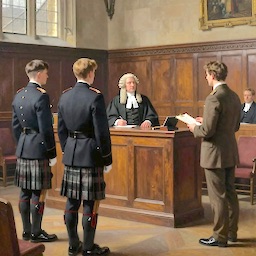 ‘Very good, then. Custody order granted, pending trial. Get a couple of paper cups from the drinking fountain and you and I can finish this off.’
As the duty policeman directed McCall and Myers down the steps back to the holding cells, McCall called out, ‘What about us?’
‘Drinking in the Court is strictly forbidden,’ said the Sheriff.
‘Slàinte agus Sunnd!’
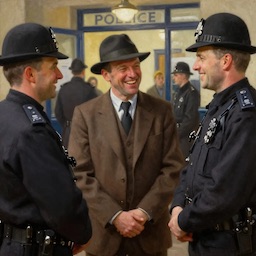 ‘How was your week-end, Sam?’
Sergeant Thomson met Rae Hardy and me just inside the entrance to the Precinct, and they both knew perfectly well how my week-end had been. ‘Saturday, catching the crooks at long last,’ I said, ‘with Rae here kindly doing the hard yards. Sunday I spent in one interview room speaking with Myers while Rae spent Sunday in the other interview room talking with McCall, when he should’ve been out washing the car, buying flowers for his wife and taking his kids to Coney Island. We swapped over occasionally so that we could entertain our suspects with the good cop, bad cop act. Then I arranged to spend five minutes in the Sheriff Court on Monday, and I borrowed Rae’s desk in the office to type out my report. Monday, Rae and I spent a couple of hours waiting our turn in the queue for the Sheriff Court and ten minutes asking the Judge for permission to lock the crooks up. And now at— ’ I looked up, ‘quarter after nine on Tuesday, I've come here to hand over my report and my bill.’
Thomson took the bill and my three-page typewritten account of events. ‘Jane can sort this out,’ he said without looking at either of them, ‘She’s out of hospital and I think just now she’s looking for something in the evidence store.’
‘And thank you, Rae,’ I added, ‘for your help over the week-end. Some day you’ll make a first rate policeman.’
Sergeant Thomson looked at the bill, swallowed visibly, and gave it back to me. He thought for a moment and added, ‘What’s sales tax?’
‘That’s for my Uncle Sam, sergeant. I have to add sales tax to all my bills.’ I’ve noticed before how customers always query the smallest item on a bill.
‘Jane can sort that out. Is your Uncle Sam a shareholder?’
‘In a way, yes. Rae added up all the pounds, shillings and pence for me. He even converted them to dollars. In your midst you’ve got a genius with a comptometer for a brain. I still can’t wrap my head around that Scottish money.’
‘If I know Jane, the money will be in New York before you are. By the way, Sam,’ Sergeant Thomson lowered his voice to a sibilant whisper as of one about to breach the Official Secrets Act in a crowded restaurant, ‘Jane’s still single.’
‘Really? I hadn’t noticed.’ Actually I had noticed because the first thing any PI does when he meets a new woman is look for the wedding band. That’s not because he might want to marry her, but because six times out of ten it’s the husband who did it. I went on, ‘Scotland’s a great place to work, but I couldn’t ever live here. I’d miss being kept awake by the rattle of the street-cars, the wail of sirens, the bailiffs banging on the door, the lost dogs whining and barking, the crackle of fire-arms and my mother phoning me to complain about her sciatica in the middle of the night. My whole life is pounding the cold, wet streets of New York, lost dogs, missing relatives sleeping on benches in the city park, wives with secret gigolos half their age, husbands carrying women’s underwear in their briefcases and stolen handbags containing two dollars fifty and a half eaten doughnut… ’
‘Forget I ever said anything about it,’ said Thomson, mildly, ‘put the receipts in my in-tray and leave the Jaguar in the car park.’
In the evidence room Jane hugged and kissed me. We crossed over the road together, and now Jane was sitting beside me in the café on Oak Row. We had our arms around each other.
‘Are you happy to be going back to New York?’ she asked me.
‘Happy to get the job done and give LBPD the bill for it. I tried to call the bank before I paid the hotel bill. A hundred and thirty pounds! Here, let me give you the paperwork.’
‘You phoned the bank over a matter of, what, five hundred dollars?’
‘It’s not a lot of money, except when the bank is taking it out of my checking account. I tried to phone them, but the cable isn’t working. If they’d answered, I would have pleaded insanity and they’d probably have believed me. I think the bank will pony up. Someone’ll tell me if they don’t. What’s more important, how did things turn out in the hospital?’
‘Smoke inhalation. Nothing burnt, thank God. They put me on oxygen for the night. After that, they noticed that I wasn’t having any trouble breathing. They took me off oxygen again and said goodbye. Don’t change the subject. Look, I never said this about any job in my entire life but… I’ve enjoyed working with you. How would you feel about,’ her hand took mine and squeezed it, ‘spending more time together?’
The idea made me smile. ‘Oh, it would never work out. I’m twice your age. I live in my office.’
Jane sighed. ‘I didn’t mean marriage. Although if you ever think it might be a bright idea…’
I thought about that. ‘You mean work together? I'm booked on the sleeper train to London tonight and there’s an airplane from London Airport to Idlewide tomorrow. If anyone ever gives me a job that needs an infusion of Scottish expertise, you’ll be the first lady I’ll call.’
Jane’s eyes lit up for a moment.‘You promise?’
‘Well, there’s a couple of things I’d have to do first.
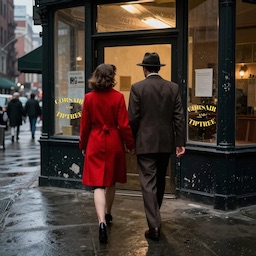 Get an office big enough for two people, that’s the first thing. Replace the bed in the office, that’s the other first thing. Buy you a desk and a chair. Then teach you to chain-smoke, clean the windows and then get a new sign made for the door. Corsair and Tiptree, Private Investigators. How does that sound? Lost Dogs and Cheating Spouses our Specialities.’
‘Don’t forget Celebrity Burglaries.’
‘Yeah. That’s what brought us together, so it’s important. Putting that on the sign will double our income, for sure.’
Around ten o’clock that night, I called a cab to the Union Station, and I hauled my suitcase around to the sleeper to London. The station was dark, it smelled of coal dust, tannoys made announcements, steam whistles were screaming and there were only a handful of people around, most of them heading for the same track as I was.
‘Sam! I’m over here.’
‘Jane! Well, this is a nice surprise.’
‘I had to come and see you off.’
We held each other close and we kissed again.
‘You made this assignment a pleasure, Jane. I really hope we work together again some time.’
‘You’re in coach B, that’s this coach here. Berth Five.’
‘I’m in coach?’
‘It’s a first class coach. They bring cups of cocoa and nips of whisky to your bunkside. And I booked you in for dinner in the restaurant car. Steak pie. The British Railways house dinner, best steak pie on earth. I even put the extra three and eight on your expenses.’
‘That was very thoughtful. How much is— ’
‘Seventy three cents.’
‘Did you just work that out in your head?’
‘No. I knew you’d ask, so I got Rae to work it out.’
‘And did Rae work it out in his head?’
‘Yes,’ Jane said, brightly. ‘Just like that.’
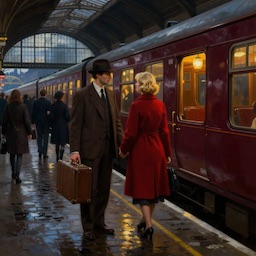 The locomotive whistled, the tannoy rattled off ‘The train at Platform One...’
‘You’d best get on board,’ Jane said. ‘I shall miss you.’
‘Me too. Very much. I’ll get your name put on the office door. Goodbye.’
Jane watched from the platform. The conductor was blowing a whistle and waving a green flag. I slammed the carriage door behind me, I found Berth Five and with a jolt the train began to move. I turned to wave, but Jane had already disappeared in the crowd. Then as the train left the station I looked around and on my pillow, I saw a box of chocolates and a hand drawn card with a heart.


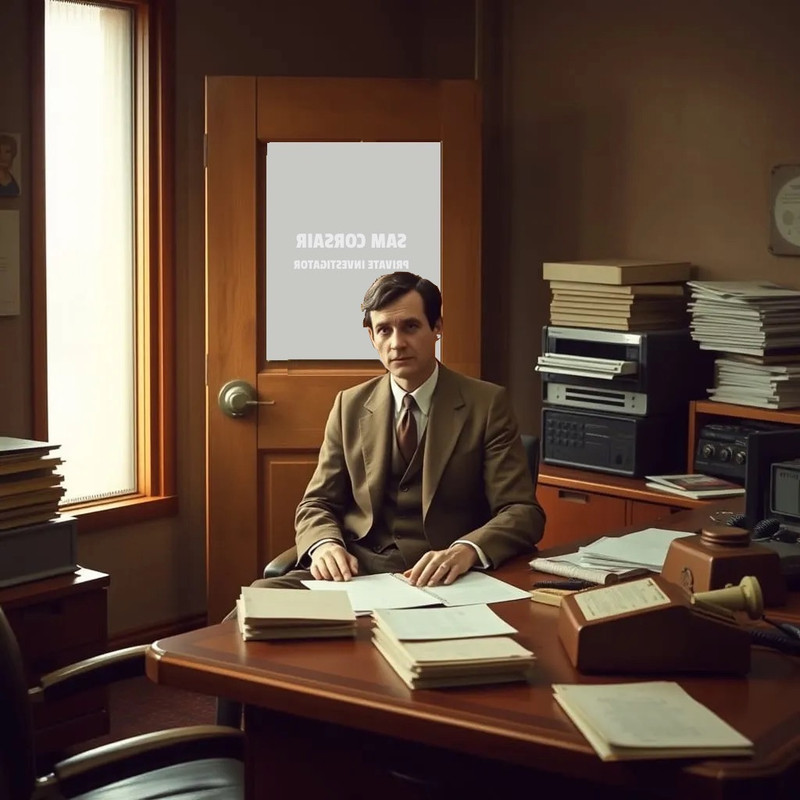 You don’t make big money doin’ this job, and I’d had a slack couple of weeks. The Inland Revenue call it ‘inconsistent case load.’ Case load was so inconsistent I was answering my own door, sweeping my own floor, making my own sandwiches and taking my own stenography. If it handnt’ve been for a rich lady from Pittsburgh losing her diamond encrusted cigarette lighter on the subway, I’d have had my creditors taking turns to kick the door down.
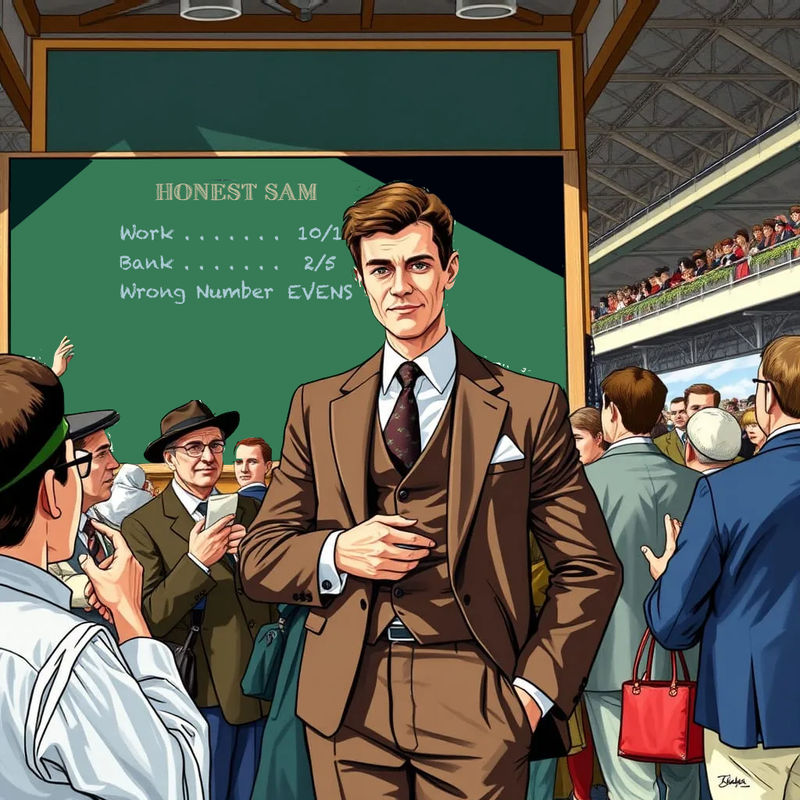 Maybe this was work. Ten to one. Or maybe it was the bank again. Five to two on. Or a wrong number, evens. Only one way to find out.
 ‘The guy you want is Batman,’ I told him. ‘Lives in Gotham City, hangs out with Alfred Pennyworth and Commissioner Gordon. Ask Gordon to let you use the red phone.’
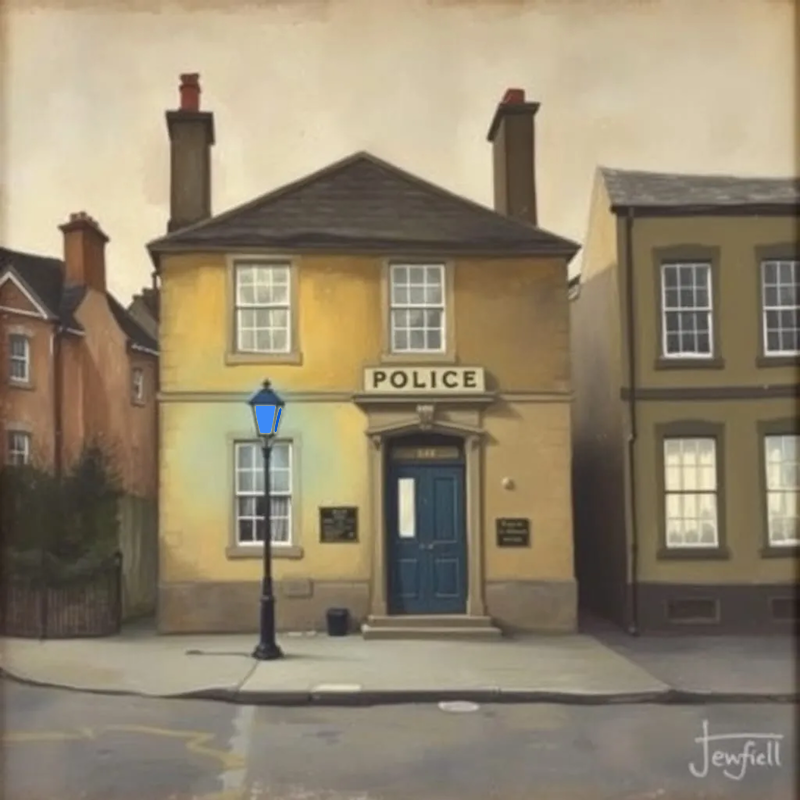 She led me from the front desk into Ellis Thomson’s office. The man himself was sitting behind the desk.
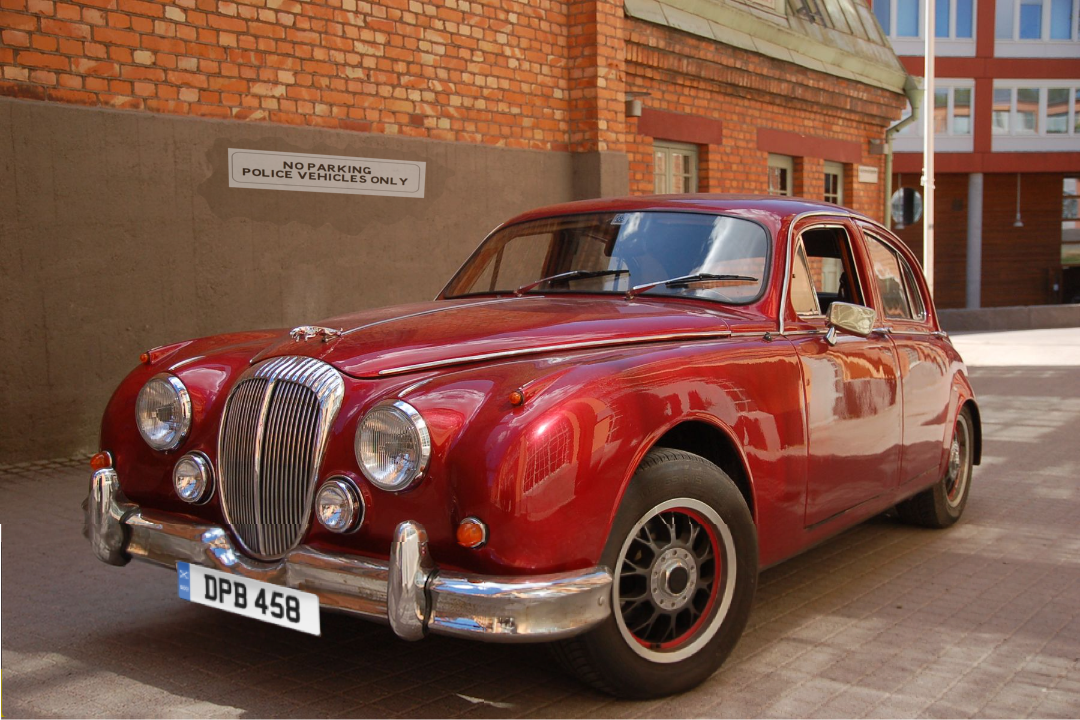 ‘The bright red Jaguar Mark One in the staff car park.’
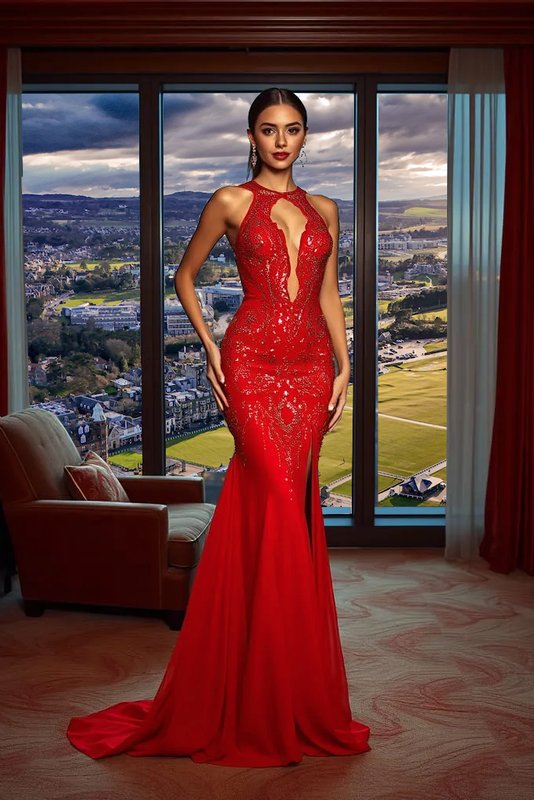 The door opened. The charming face and blonde hair that I recognised from a thousand margarine commercials looked straight at me and spoke pure California. Her hair was a bird’s nest, her dress was crumpled, her eye make-up was running down her cheeks and the mingled aromas of costly perfume and superior cognac flooded over me. ‘You’re new to Scotland, aren’t you, Officer?’
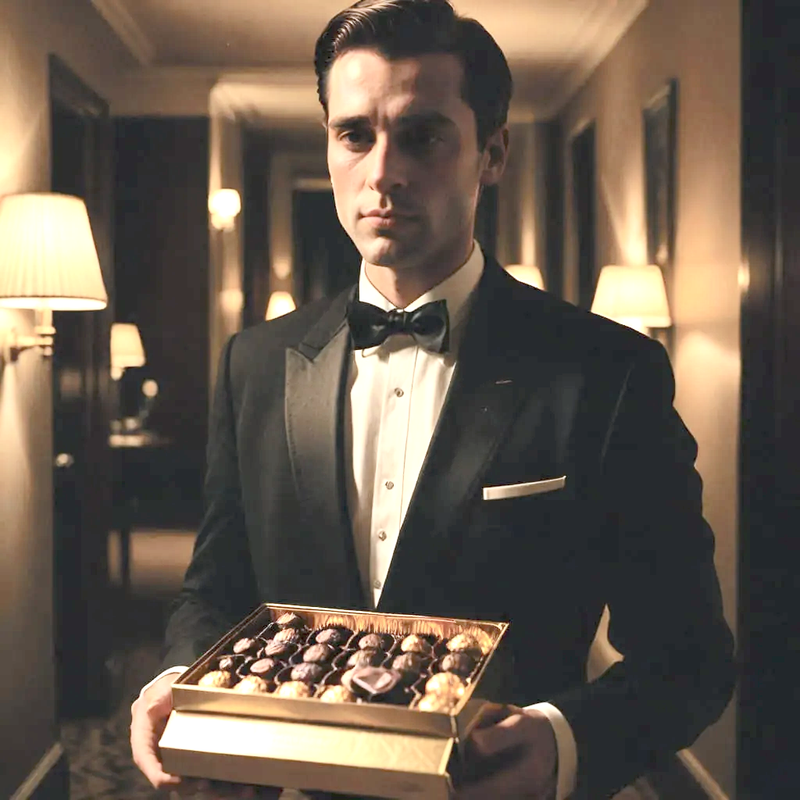
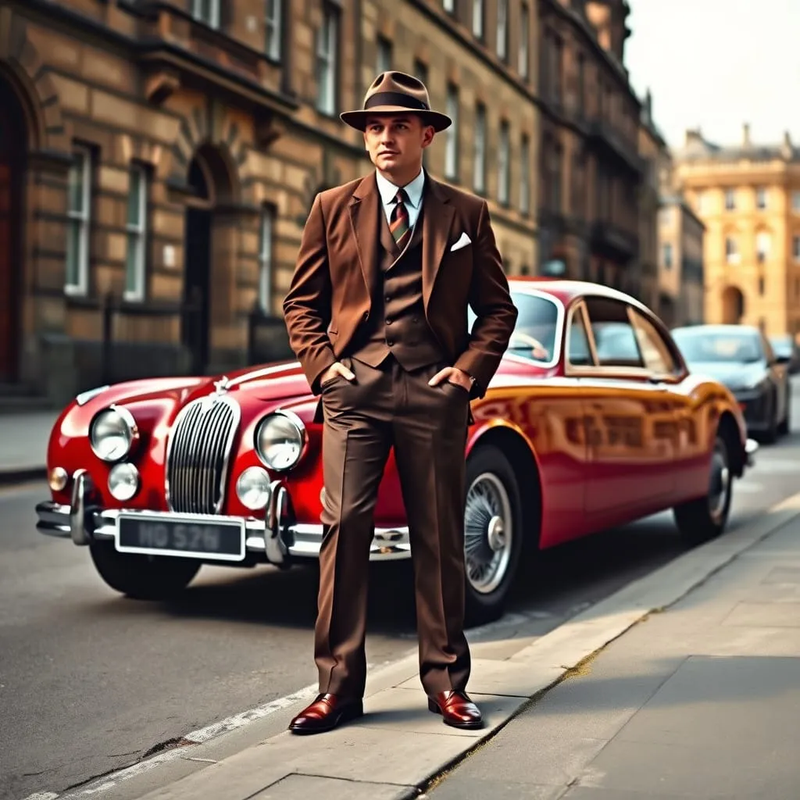 With the slice in the dash, I started the car and headed to Moray Circus a couple of miles away. It was a short, curved street, specially designed so that there was nowhere you could park by the kerb and not be run into by a speeding fire engine, or a ten ton truck being driven like one. Number 60 was a dusty wooden door with a fan-light and a brass handle that worked the doorbell. I’d found the right place. There was a very respectable black metal plate on the door with gold coloured writing etched on it. Spring Cleaning. First floor. Ring bell and wait, so I rang, I heard a bell ring somewhere on a floor above me, and I waited.
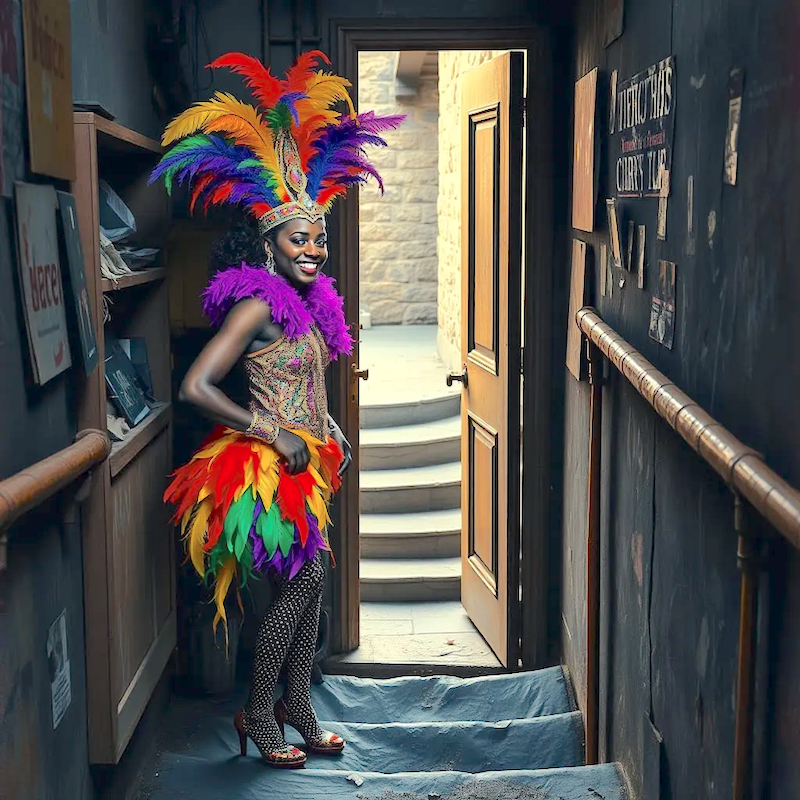 A slender Black woman in a flamboyant, brilliantly coloured Carnival outfit opened the door. If you’d caught sight of that outfit out of the corner of your eye, you’d have thought the room had caught fire.
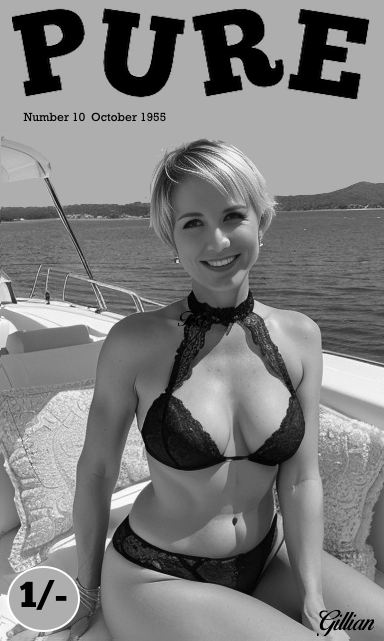 ‘She’s been in
Pure.
‘She’s been in
Pure.
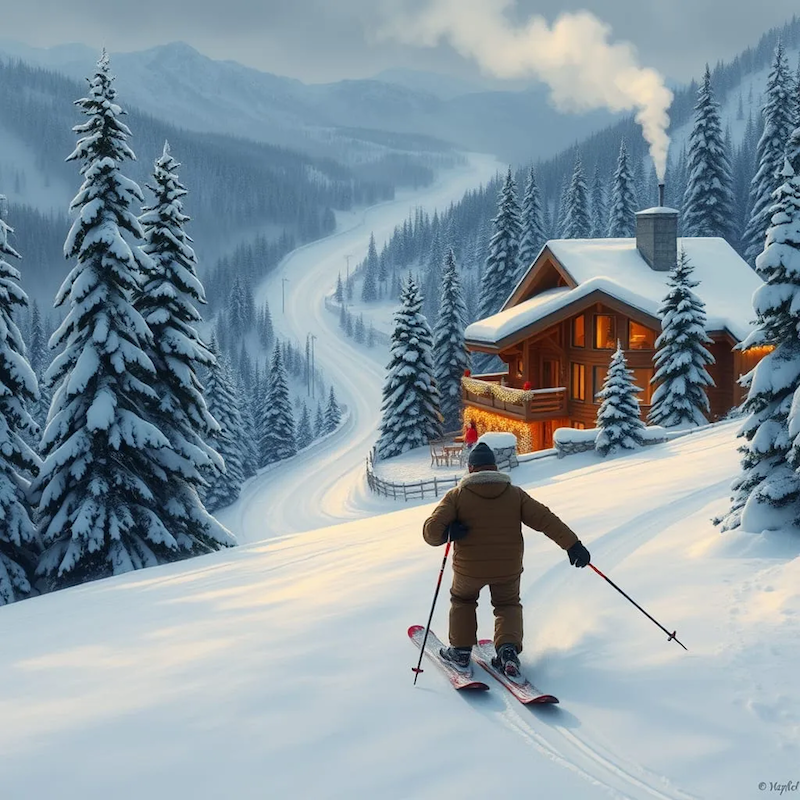 ‘Ski-ing downhill to a chalet … May I see that photograph? Thanks … to a chalet which has a perfectly good road past its front door.’
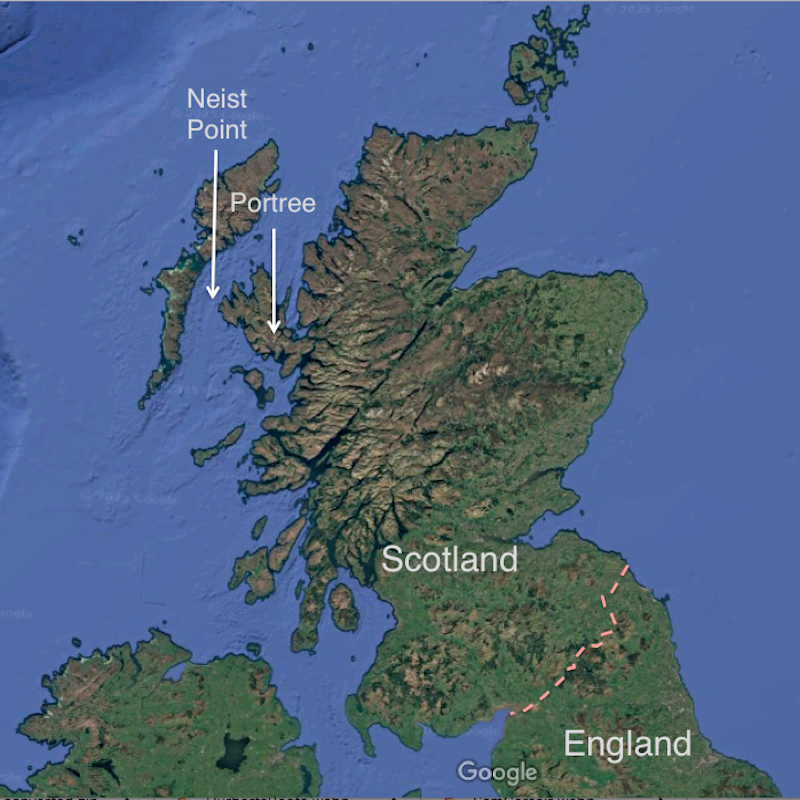 Now listen to this: On 2 November this year, she was a passenger on a small boat,
M. V. Cluaran an Luchd-siubhail,
registered in Portree and licensed to carry four crew and eight fare-paying passengers on pleasure trips close to shore.
Now listen to this: On 2 November this year, she was a passenger on a small boat,
M. V. Cluaran an Luchd-siubhail,
registered in Portree and licensed to carry four crew and eight fare-paying passengers on pleasure trips close to shore.
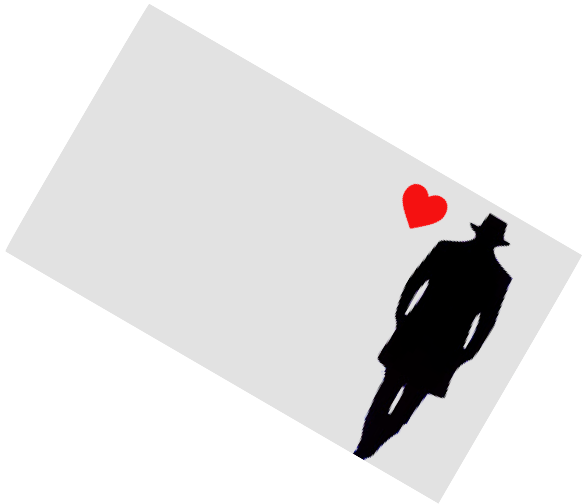 And he left his calling card and a box of chocolates where the lady would find it when she returned. Or in Miss Humphreys’s case, when she woke up.’
 Jane had told me that seven thirty was a good time to have dinner. At seven thirty, I was alone in the restaurant at the Sandringham, going over what I knew and trying to get the measure of it all.
 We ate, we talked about anything but the case, and when we finished Jane asked if we could go for a joy-ride. ‘Let’s drive to The Puddles. I’ll point the way.’

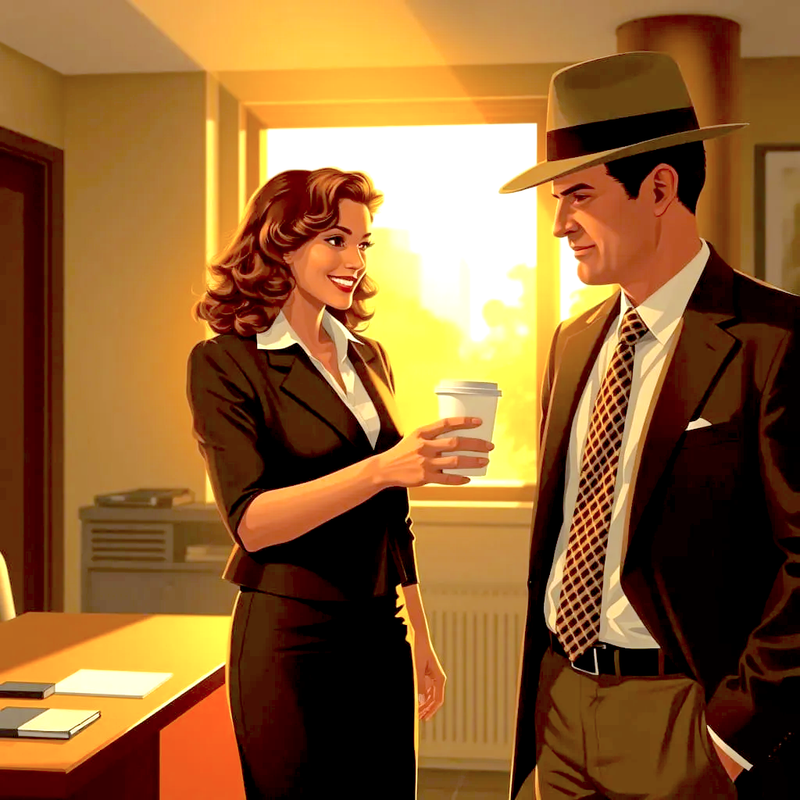 As soon as I went inside, Jane called to me. ‘Morning, Mr Corsair! I got you a coffee!’ She handed me a paper cup of coffee and added quietly, ‘Remember, half past seven tonight is dinner time.’
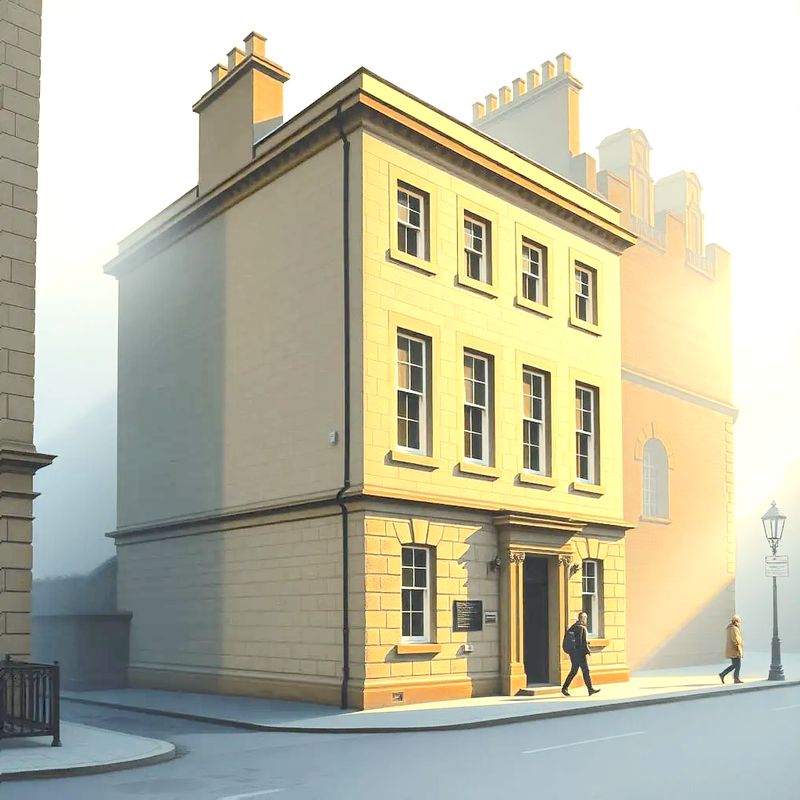 As for J. S. Trading Ltd., Ellis didn’t remember the company featuring in the case, and suggested that I try asking about it at Scottish Companies House. ‘They’ll tell you everything you don’t need to know,’ he said reassuringly, ‘and a lot more, if you don’t shut them up.’
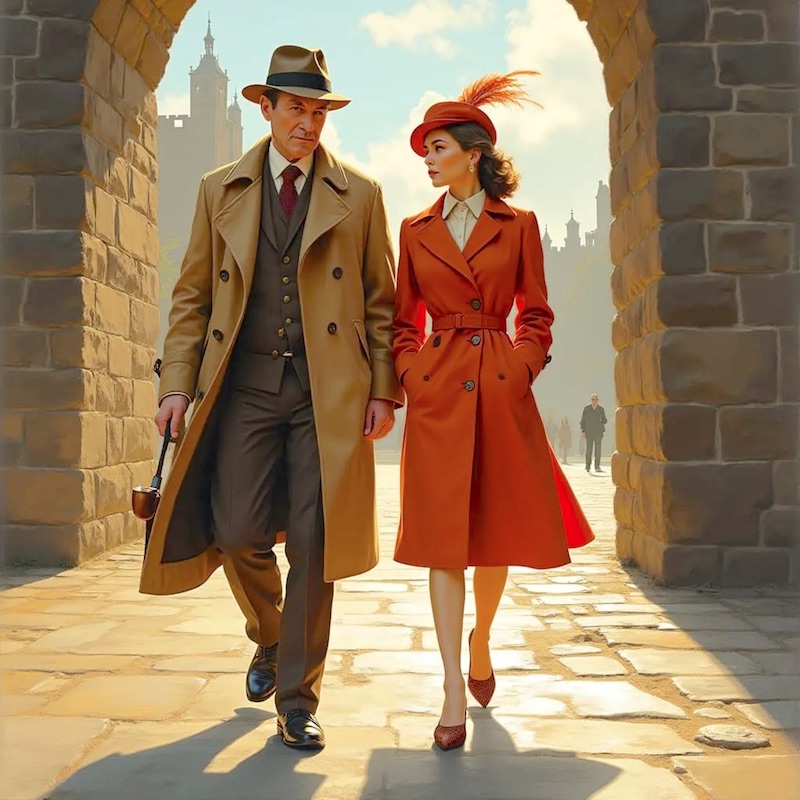 We walked through the gate, out of the castle, downhill towards the city.
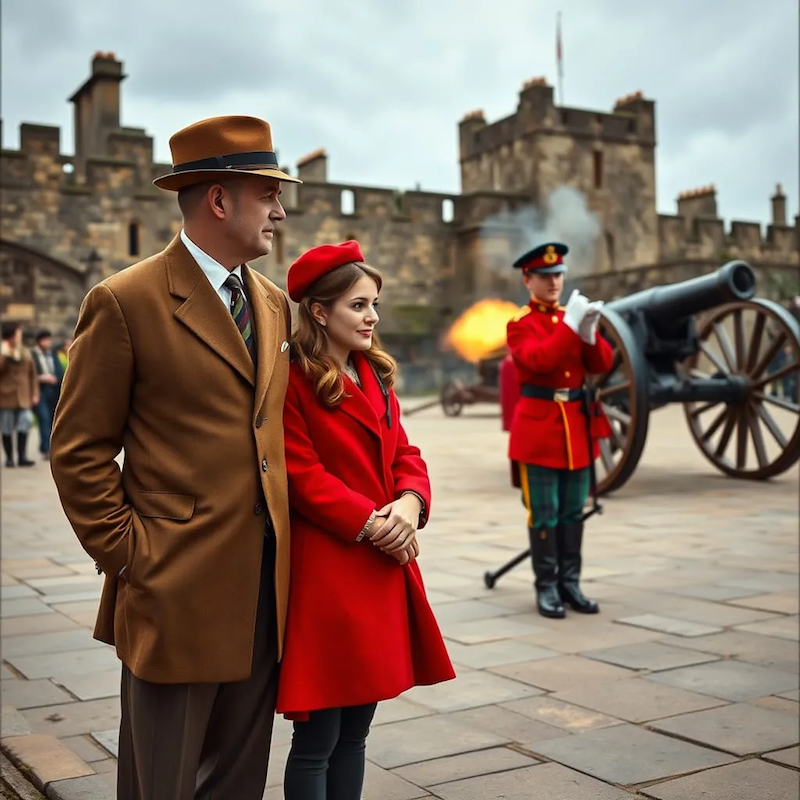 ‘Sam, it’s the one o’clock gun. It’s the cannon that you were looking at half an hour ago.’
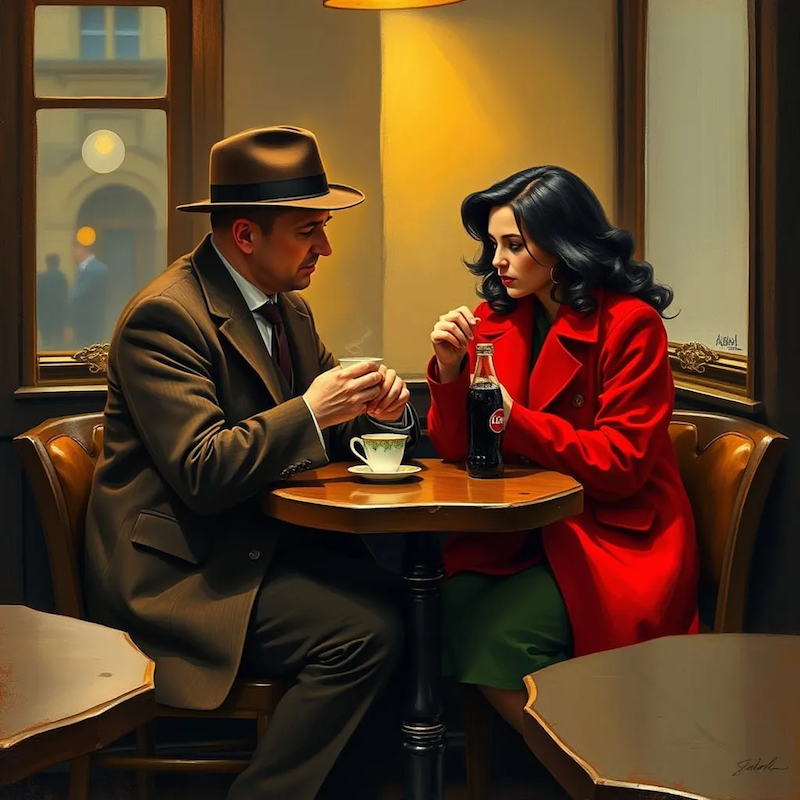 ‘Oh, look on the bright side.’ Jane squeezed my hand. I turned towards her and she kissed me. ‘You showed everyone what to do if a gunfight starts. That could save someone’s life, especially if the English invade. Why don’t we sit in that coffee-shop over there and cool off a bit.’
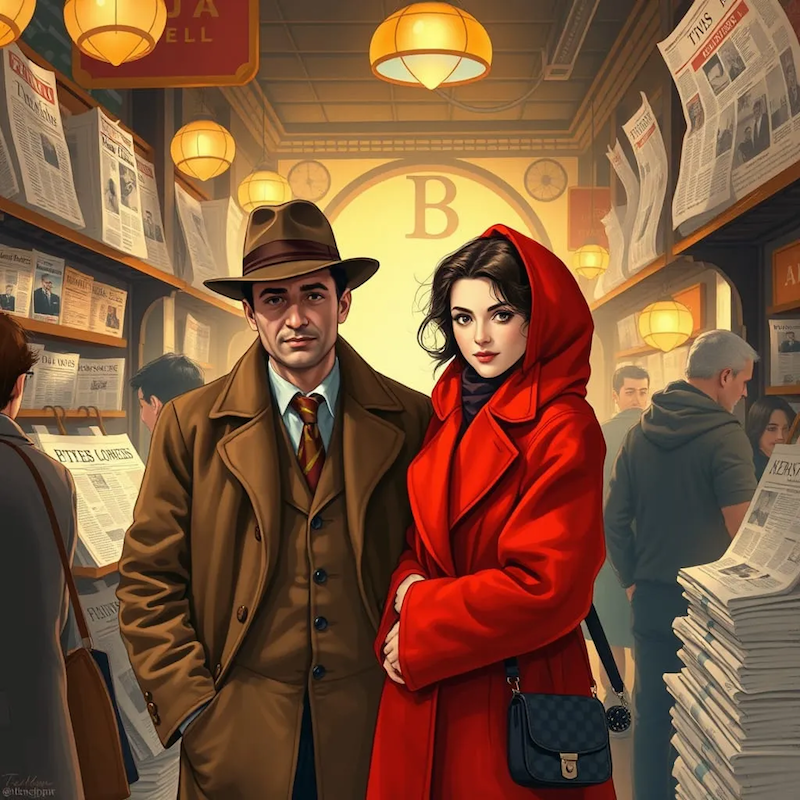 They say you only know there’s a God because of the co-incidences.



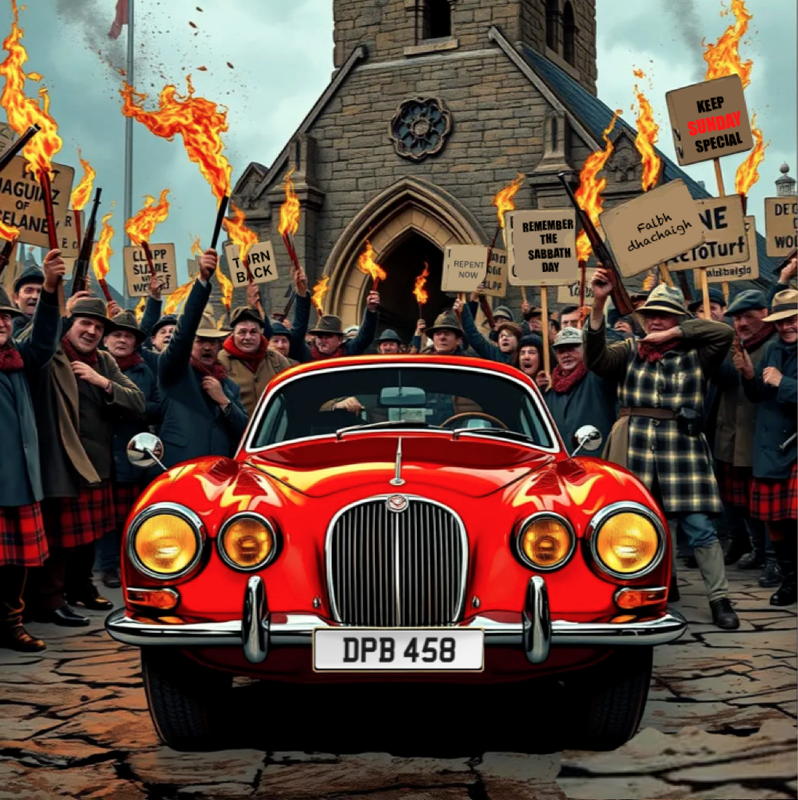
 ‘Anything else?’
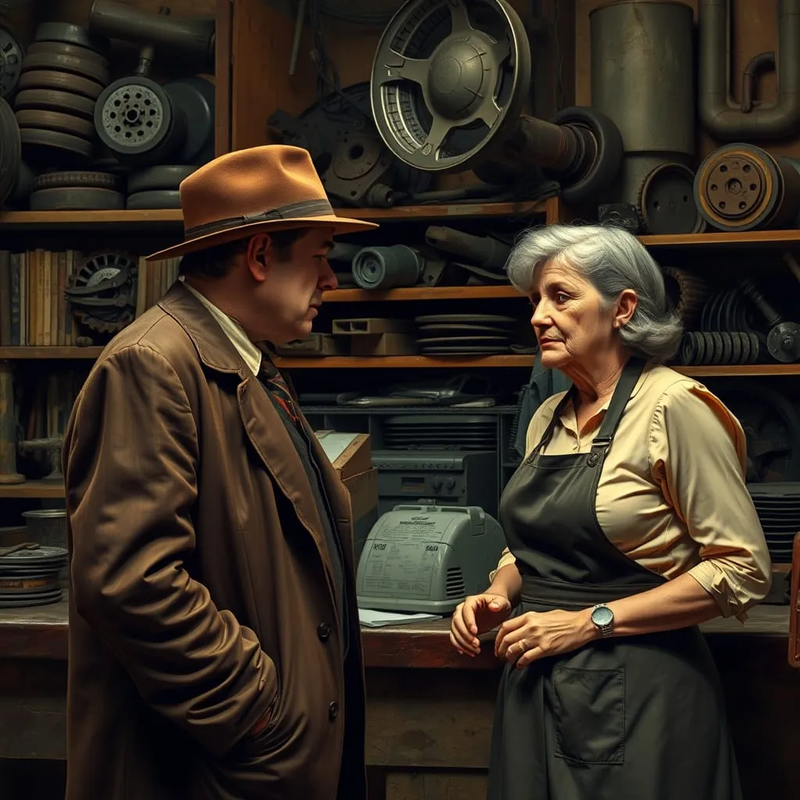 A bell tinkled as I opened the door of Fix A Car. It was a dim and dingy place with dusty boxes of parts on every hand, and most of them looked as though they had been there since before the War. The shopkeeper turned to look at me, and I asked if she had a gearstick knob like the one I was holding.
 Jane was suddenly alert and looking keenly out of the window.
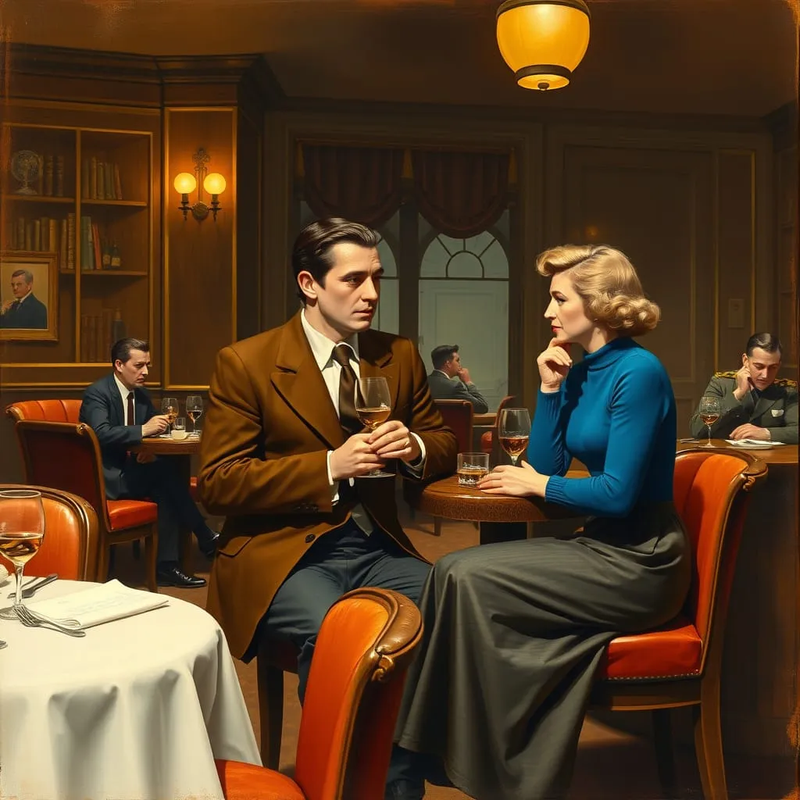 As you would expect in the depths of winter, The Duke’s Hotel was three quarters empty. We arrived around nine in the evening, just before last orders, when the crew in the kitchen were hoping that there wouldn’t be any more customers arriving and they could pack up and go home early. Sitting around us at the polished wooden tables in the bar drinking Rìoghail whisky or Aulder’s beer were a man in a suit and tie who was probably a representative selling whatever he sold to the enterprises of the town, a couple of men in grey tweed overcoats and homburgs who might have been locals passing the evening in front of the peat fire, a couple who looked like man and wife in Portree for a winter holiday, and two young men in what looked like khaki Army fatigues. I guessed they might have been commandos or Special Service — tough guys if ever there were any — recovering from exercises in the Cuillin Hills. From what I had seen, the hills looked as demanding a territory as any army could have ordered its crack troops to survive in.
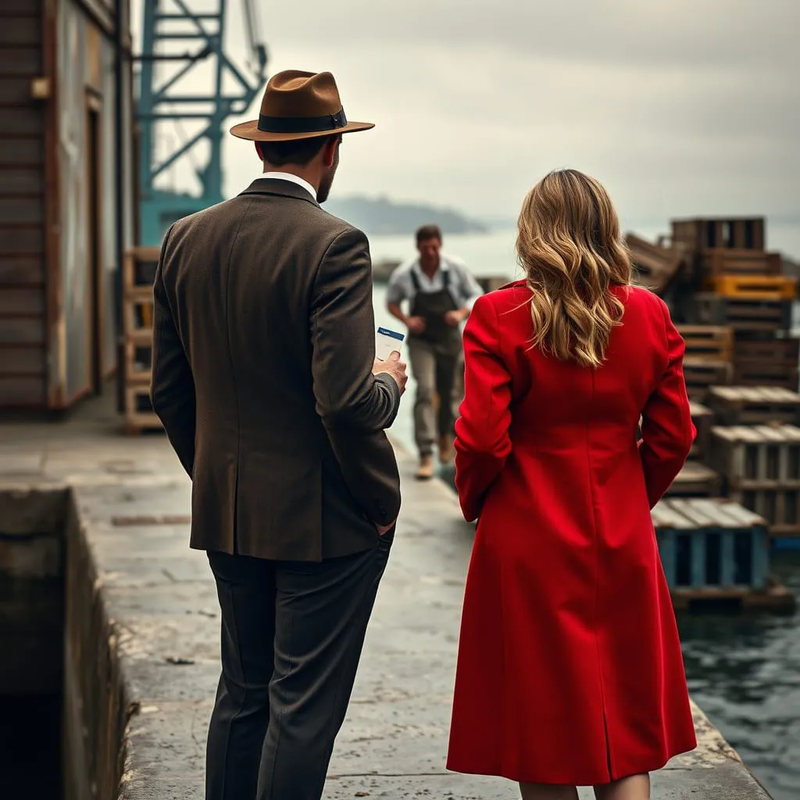 He dropped the box onto the pier and ran towards the shore. The crate crashed on the stonework of the pier with the sound of shattering glass. Running, he tried to dodge Jane and me and swerve around the stack of boxes that he’d been piling up ahead of him. He tripped and fell over the side, yelled and splashed into the water. Unable to swim, he was panicking and looked about to drown. I saw a lifebelt in a cabinet, grabbed it and tossed it towards him as accurately as I knew how. Missed. It landed uselessly, ten feet or more away from him. I realised that you were supposed to throw the belt beyond the drowning man and then pull the rope to bring the belt within his reach, but at that moment, as miraculously as it was unexpectedly, Jane’s training as a Special Constable suddenly took her over, as a puppeteer takes over a marionette. Blink and you’d have missed it. She threw off her coat, her outer clothing and her shoes, called out ‘Keep those dry for me,’ dived into the sea and landed within arm’s reach of what was quite definitely a fleeing crook. She even got hold of the life-belt.
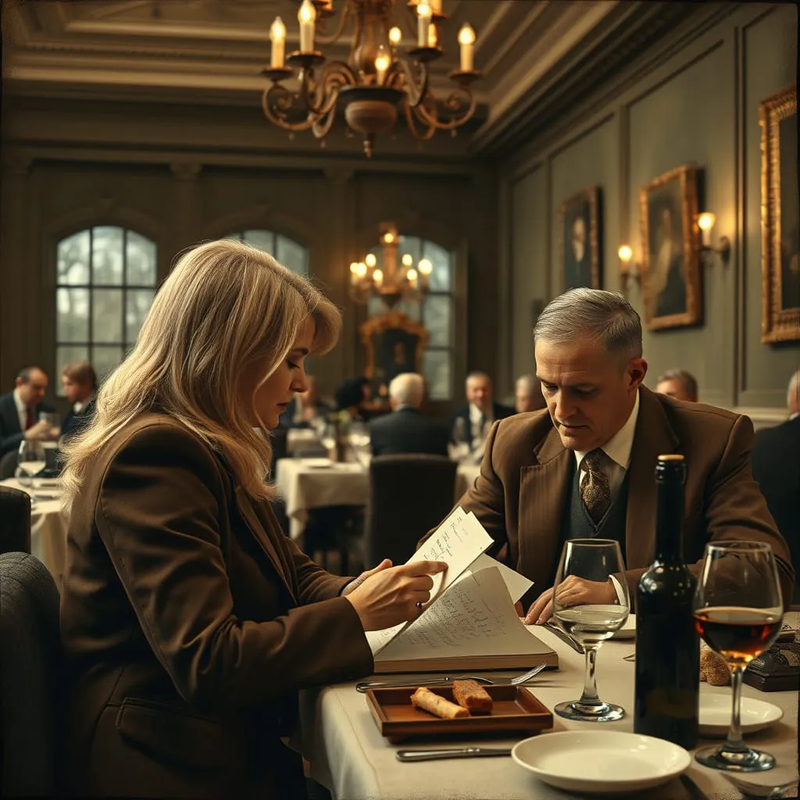 Over the dinner table at the Duke’s Hotel that evening we opened out the copies of the passenger manifests of those two journeys which M. V. Cluaran an Luchd-siubhail had made. The first one had ended in some kind of disaster involving a man overboard. The second manifest showed the same passengers. Eight passengers were on the list.
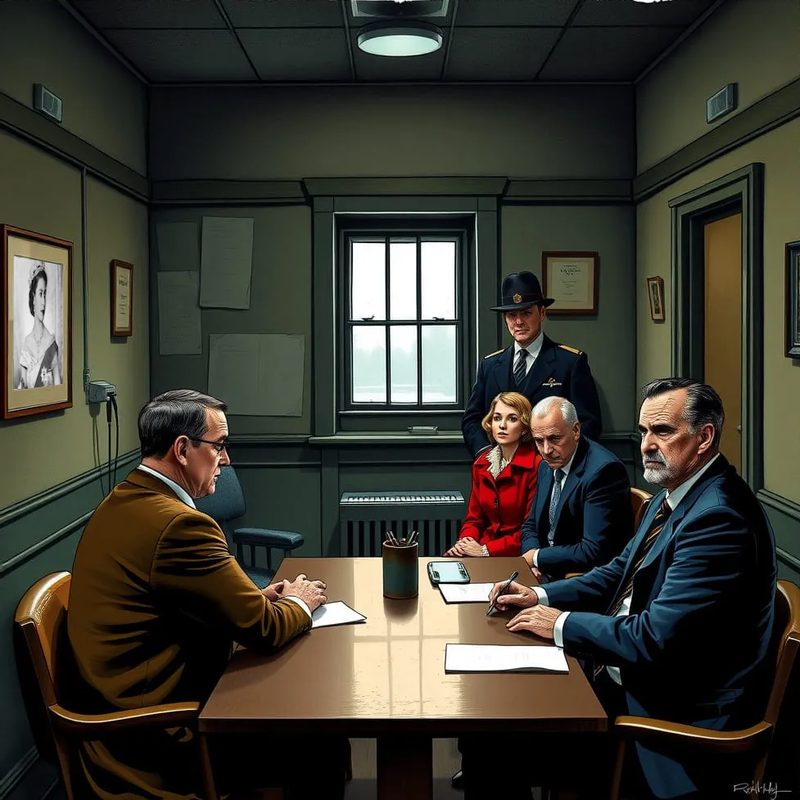 There was a sound of footsteps and chatter on the other side of the door. Constable MacReary came into the room, bringing with him the man whom we had arrested yesterday on the pier. He was wearing a sky blue suit jacket and pants, a pink shirt and a black and white striped club tie. I couldn’t see the socks but I thought they probably glowed in the dark.
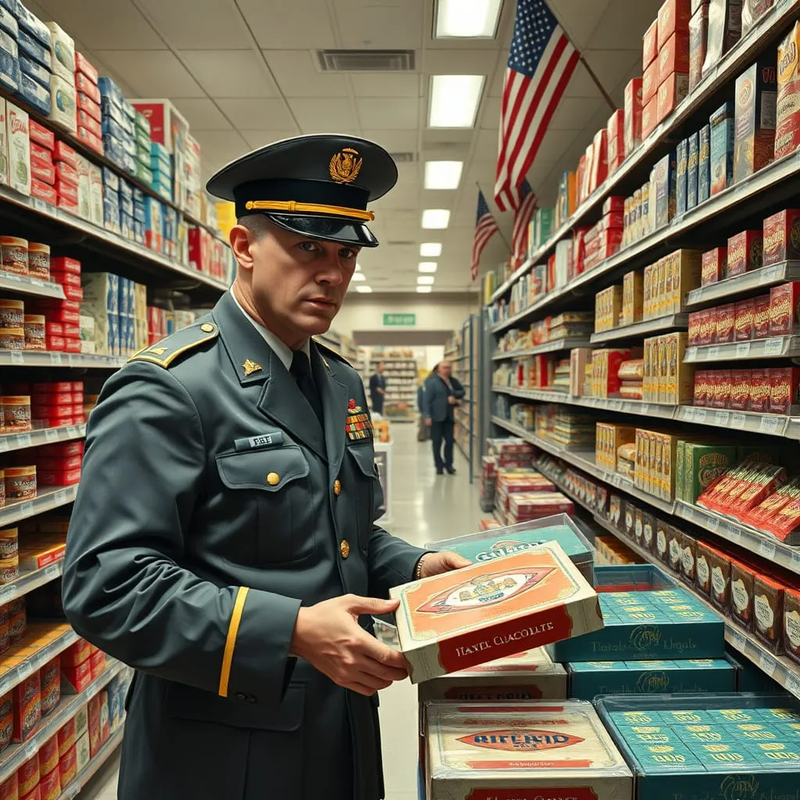 ‘Indeed so,’ I said, and I turned to McCall. ‘Major McCall, with your lawyer’s permission, may I ask you, can you buy Chertsey chocolate assortments in U. S. S. Moore?’
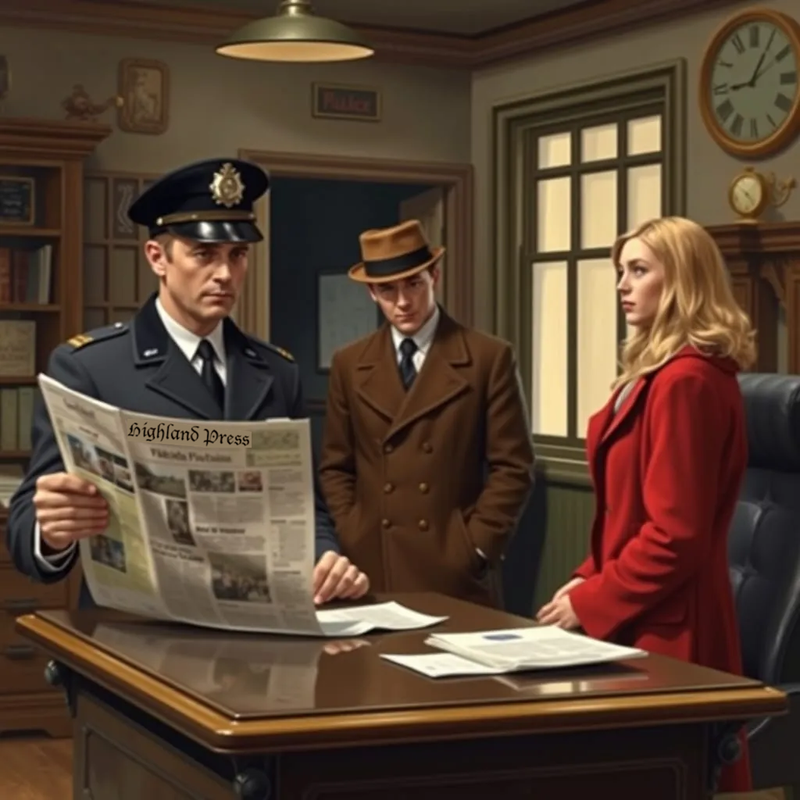 ‘The court report says the Sheriff accepted that resisting arrest was a minor offence,’ he told us. ‘All McCall had done was run away, he wasn’t charged with anything except resisting arrest, and he’d suffered enough, what with falling in the water and spending a night in the cells, so… Fined two pounds.’
 ‘In defeat, defiance, as Franklin D Roosevelt once said.’ I quoted, ‘it’s time to retreat to Operational Headquarters for the inevitable After Action Review.’
 Jane and I had more thinking to do, which meant we needed more coffee. I was on the brink of ordering when we saw a man stand up and walk towards us. Clearly he wanted a word.
 After three minutes or so, Brisling bustled back into the hut, where Jane and I were sitting hoping in vain that an orderly would knock on the door with a tray of coffees.
 ‘Better to hide up a tree,’ said Jane. ‘Once their faces appear on Wanted posters, you’ll be safe as houses. ’
 We were interrupted by a knock on the door and a shout. ‘Duty orderly, sir. Coffee?’ Brisling opened the door. The orderly had a trolley with cups, a coffee urn and everything else a demanding and thirsty officer might want.
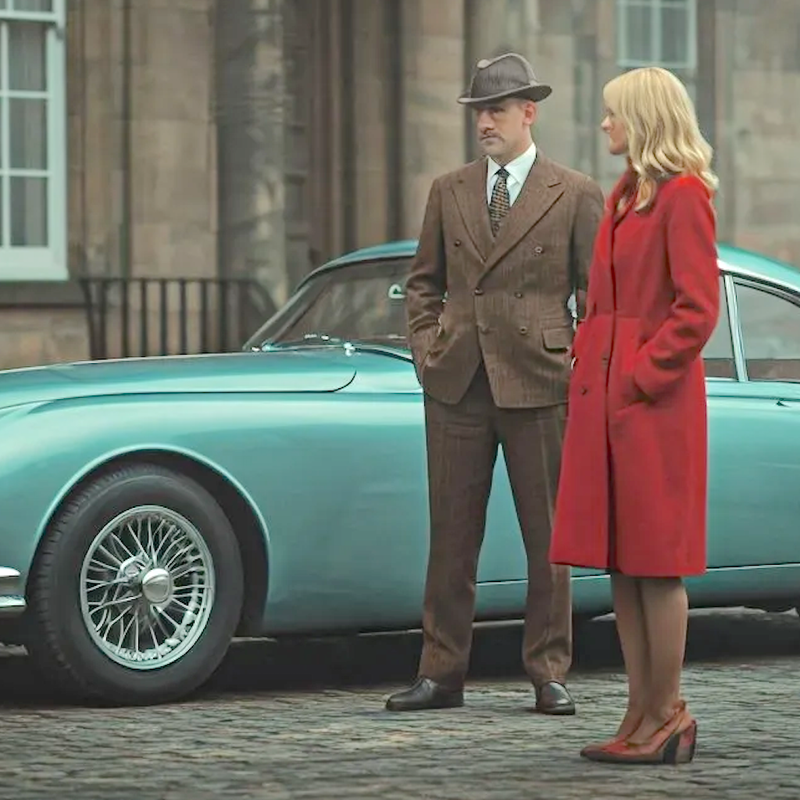 Jane and I awoke together in the hotel. Breakfast was the usual luxurious affair, large portions of anything we wanted, then I suggested to Jane that today might be a good day to go looking for Alvin McCall.
 ‘She called me up and told me. Come with me, yeah? You’ll get paid provided I can put your overtime on expenses. What’s your fee for a week-end day?’
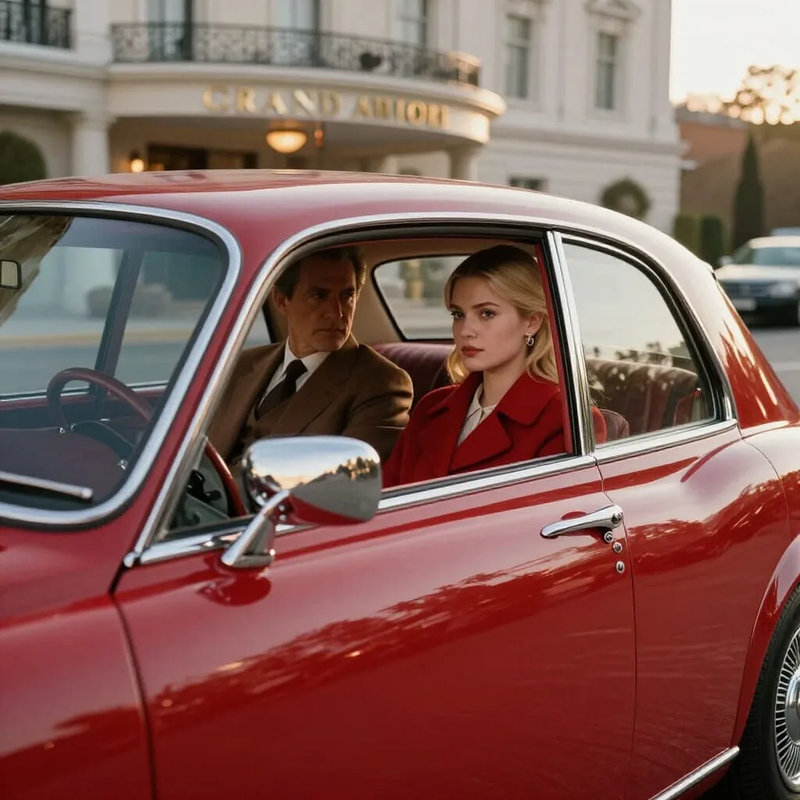 We drove across town to the Grand Azure. We found a spot in the car park where, with luck and a following wind, we could observe who came and who went, while attracting little attention. The vigil began.
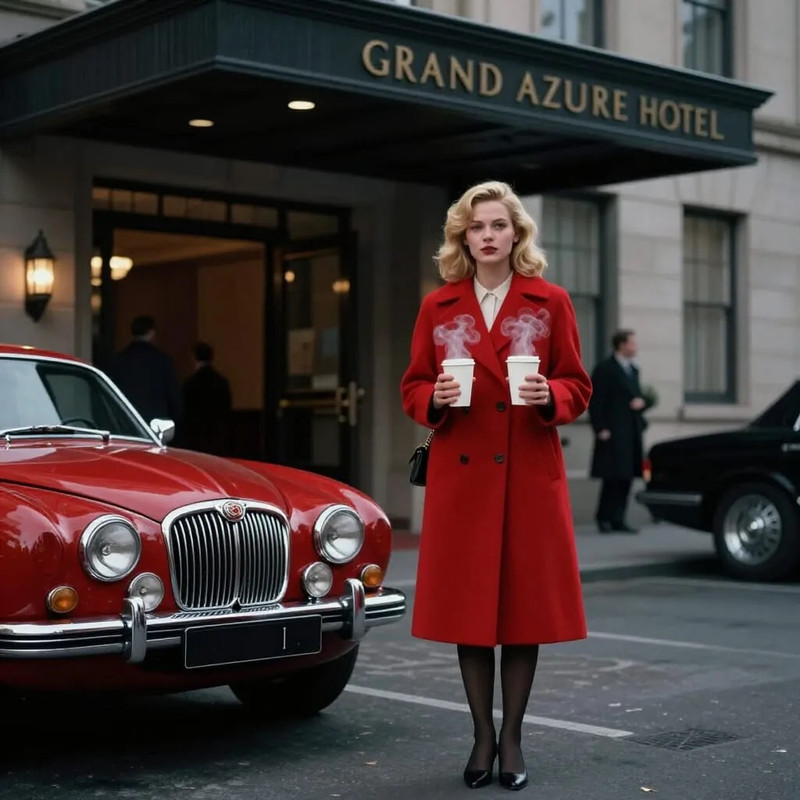 I know everything there is to be known about surveillance. Wearing the hat of a private eye has given me long experience skulking in the shadows on the mean streets. Here I was doing the same job in Scotland, parked in a borrowed Jaguar Mark One with my beautiful assistant half my age, Special Constable Jane Tiptree, watching and waiting outside the Grand Azure Hotel for we knew not what.
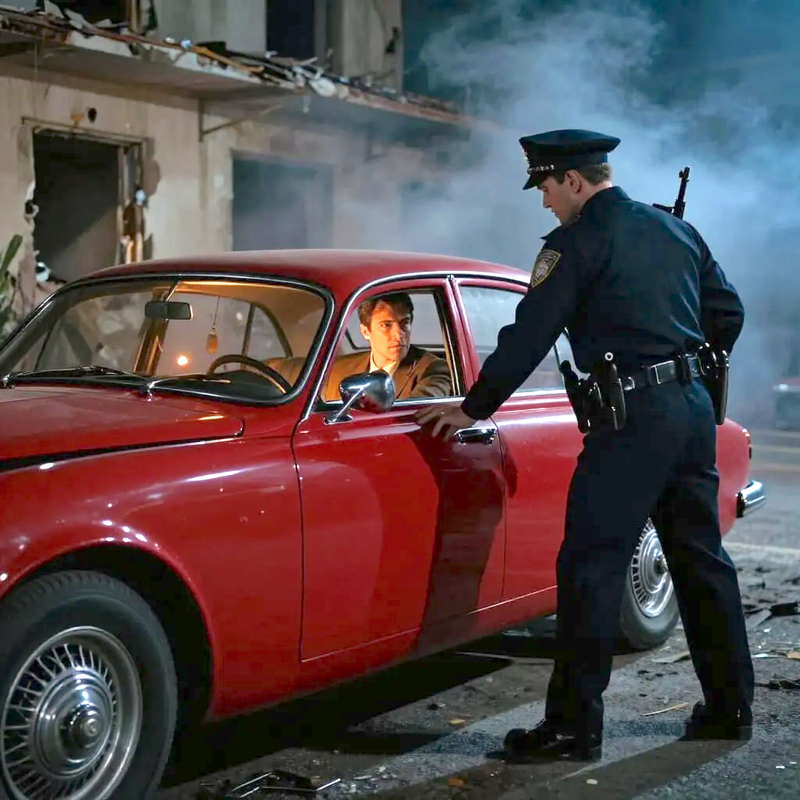 ‘Wake up, ’tec! It’s the cavalry.’
 A woman, in her fifties I guessed, came over to us and asked whether we were all right — we were — and she asked whether she could do anything to help us. She’d seen the Policeman in the passenger seat and suddenly felt overwhelmed by sudden bursts of compassion and curiosity. I said yeah, you could fetch us two hamburgers with cheese and extra onions and two cups of coffee from the nearest McDonald’s and don’t tell anyone that we’re here.
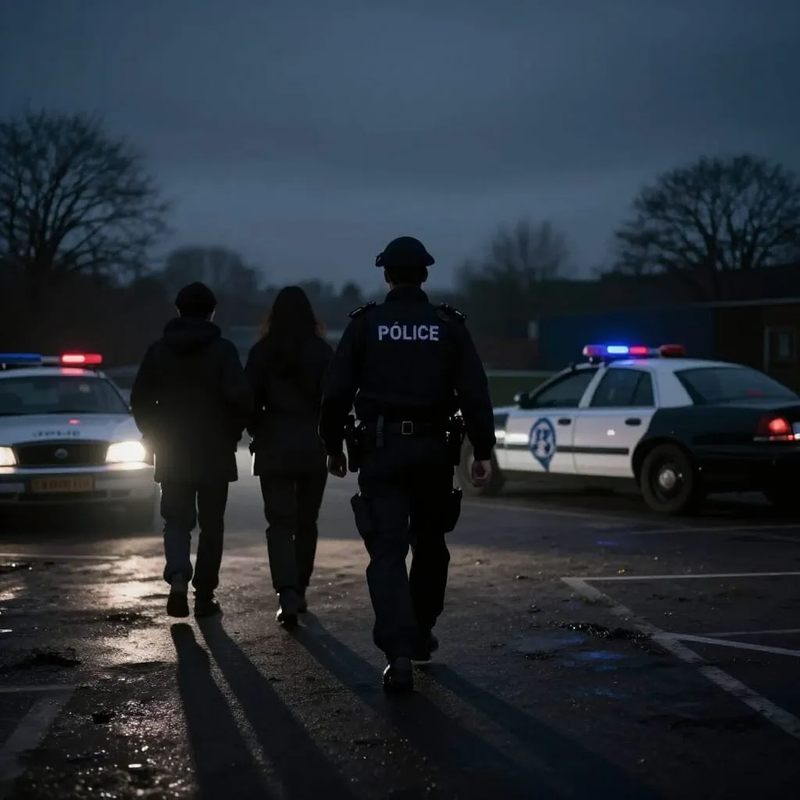
 Sheriff MacDougall picked up the sheets of paper in front of him and looked straight at Rae and me.
 ‘Very good, then. Custody order granted, pending trial. Get a couple of paper cups from the drinking fountain and you and I can finish this off.’
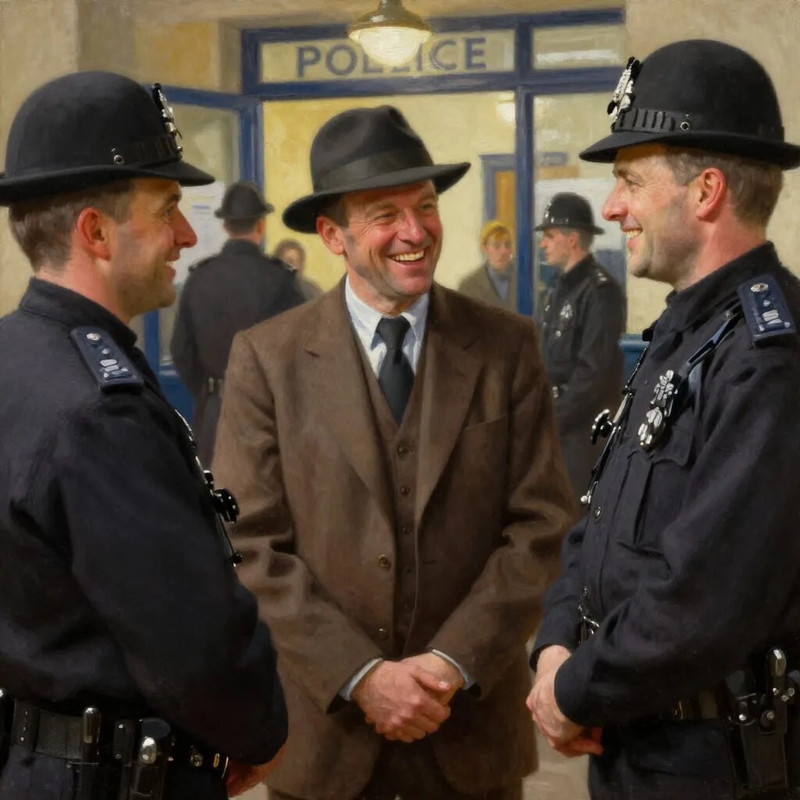 ‘How was your week-end, Sam?’
 Get an office big enough for two people, that’s the first thing. Replace the bed in the office, that’s the other first thing. Buy you a desk and a chair. Then teach you to chain-smoke, clean the windows and then get a new sign made for the door. Corsair and Tiptree, Private Investigators. How does that sound? Lost Dogs and Cheating Spouses our Specialities.’
 The locomotive whistled, the tannoy rattled off ‘The train at Platform One...’


